Programme Overview
The Bachelor of Accounting Programme of the Posts and Telecommunications Institute of Technology is designed to meet the needs of society for high-quality accounting human resources in the context of international integration and digital economy. The Programme equips students with comprehensive knowledge of financial accounting, management accounting, auditing, tax and financial analysis. At the same time, the Programme focuses on developing information technology skills, critical thinking, communication and professional ethics.
The Programme ’s learning Outcomes are designed in alignment with the Vietnamese Qualifications Framework and referenced against international standards such as the QAA Subject Benchmark Statement for Accounting, ensuring relevance and global integration. Graduates are capable of applying their knowledge in various working environments, including businesses, public organizations, non-profit organizations, and international institutions, and are prepared to adapt to the rapid changes of the digital economy.
Programme Learning Outcomes
The Programme Learning Outcomes (PLOs), competency levels, and performance indicators (PIs) of the accounting Programme are as follows:
PLO PI Rubric V2 (Cohort 2025–2029)
| Output Standards (PLOs) | Ability Level* | Indicators (PIs) |
| PLO1. Apply fundamental scientific, economic, management, and accounting knowledge to solve accounting-related problems. | C3 | PI1.1. Identify problems in the field of accountingPI1.2. Apply basic science, economics, management and accounting knowledge to successfully solve accounting problems |
| PLO2. Accurately perform professional skills to meet the requirements in the accounting field | C4/P3 | PI2.1. Accurately perform skills in preparing documents, recording books, preparing accounting reports and making decisionsPI2.2. Correctly perform the procedures in the audit process and prepare the audit report.PI2.3. Accurately perform financial analysis skills |
| PLO3. Critically evaluate arguments about issues in the accounting field. | C5/P2 | PI3.1. Analyze arguments regarding issues on accounting, auditing, tax and financial analysis PI3.2. Evaluate arguments regarding issues on accounting, auditing, tax and financial analysis |
| PLO4. Accurately perform digital skills in the accounting field | C3/P3 | PI4.1. Correctly use digital technology to support solving problems in the field of accountingPI4.2. Exploiting data and information on digital content for accounting purposes |
| PLO5. Communicate effectively in the accounting field | C3/P3 | PI5.1. Develop different types of accounting documents appropriate to the context and regulationsPI5.2. Prepare and deliver accurate presentations |
| PLO6. Adapt to activities in a team environment to perform accounting tasks | C3/P3 | PI6.1. Identify one's own role and level of participation in group activitiesPI6.2. Collaborate with members to resolve accounting issues |
| PLO7. Comply with ethics and professional responsibility of accounting | C3/A2 | PI7.1. Apply ethical principles and professional regulations in accounting situations (C3)PI7.2. Professional attitudes and behaviors in accounting (A2) |
* C: Cognitive domain; P: skill domain; A: attitude domain.
Competency levels are determined based on Bloom's Taxonomy of Thinking.
Curriculum Structure
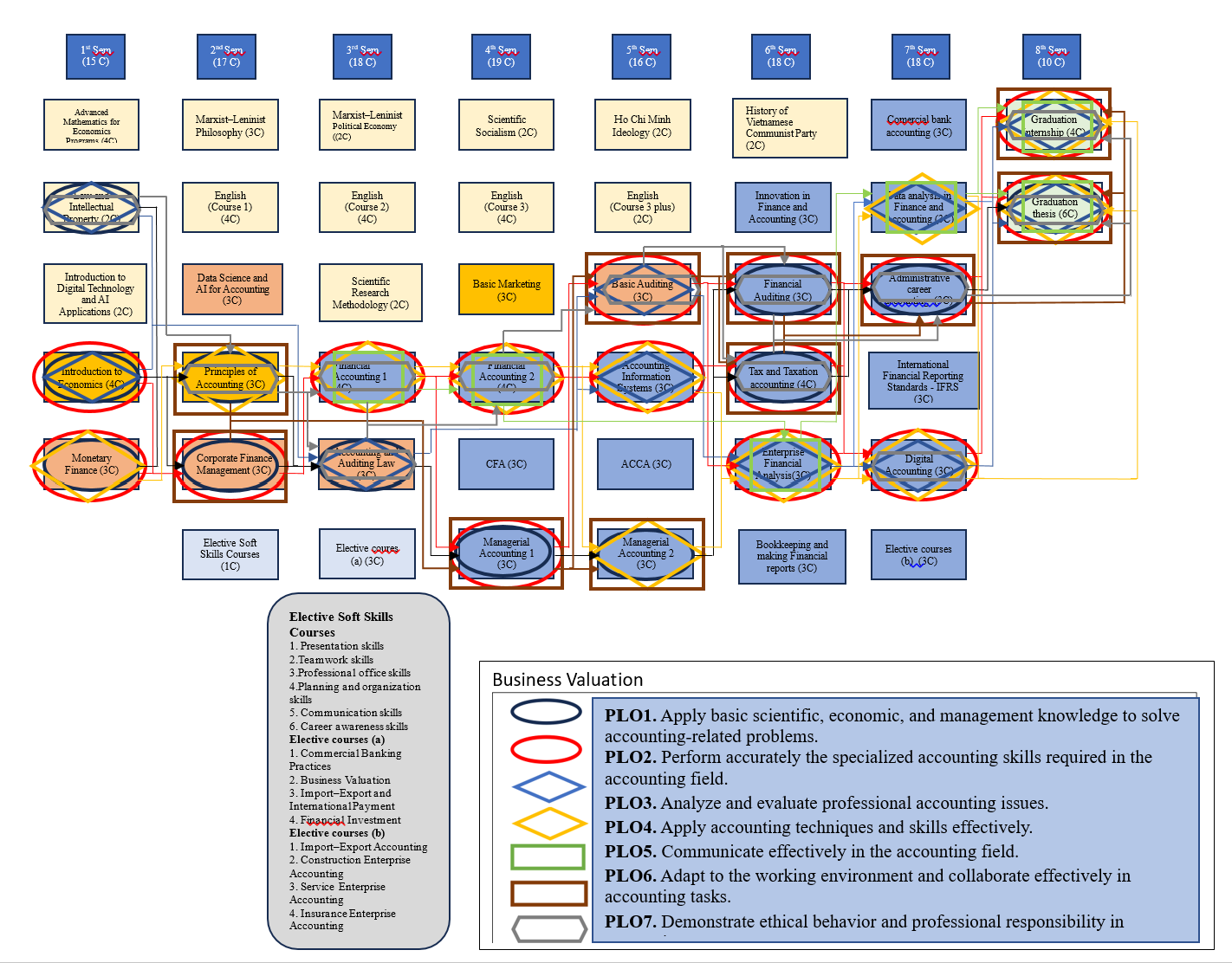
Course Matrix
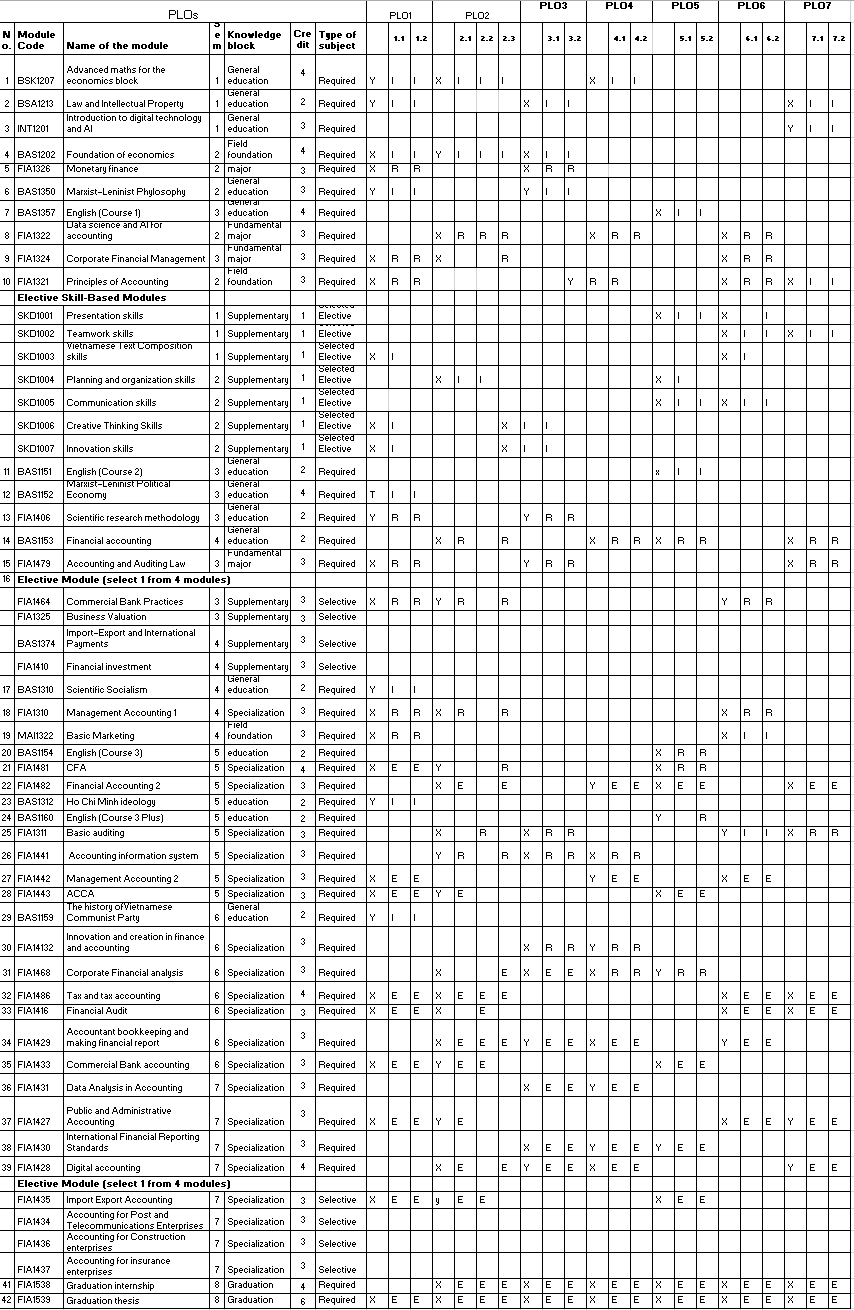
Career Opportunities
Employment opportunities:
(1) Graduates are capable of effectively taking on positions in accounting functions within domestic and international enterprises, ministries, government agencies, joint-venture units, banks, and other organizations; professional accounting consulting firms: accountant, internal controller, financial-banking-securities analyst, accounting-finance consultant, tax specialist, auditor, tax officer, risk management officer, audit assistant, and accounting-audit-tax-finance consultant.
(2) Graduates can establish their own businesses in the field of accounting and pursue private business opportunities: start a company specializing in accounting services – tax consulting – financial management consulting.
(3) Graduates can pursue careers as researchers or lecturers in accounting and auditing at research institutes, research centers, and educational institutions: university teaching assistant, college lecturer, researcher at accounting-auditing-finance-tax research institutes.
Further study opportunities:
After graduation, students can pursue master's Programme s in the fields of accounting, auditing, finance, business administration or economics to expand their knowledge, improve their management skills and conduct in-depth research. With a long-term academic orientation, students can also continue to study for a doctorate to become lecturers, researchers and contribute to the development of knowledge in the fields of accounting, auditing and finance. In parallel with the academic path, the Programme also creates a foundation for students to pursue international professional certificates such as ACCA, CPA Australia, CIMA or CMA.
Admission Requirements
Programme Admission Requirements
Applicants must have graduated from high school or an equivalent level, and must participate in and be admitted (meeting the entrance requirements) to the full-time undergraduate admission process with one of the subject combinations: Mathematics, Physics, Chemistry (A00 – Block A); Mathematics, Literature, English (D01 – Block D); or the Institute’s separate admission methods of the Posts and Telecommunications Institute of Technology.
Admission methods
The accounting Programme offers various admission methods, such as admission based on the results of the high school graduation examination, combined admission (English proficiency + academic transcript), direct admission for national excellent students, admission based on the results of competency and thinking assessment tests. The admission process follows NEW8808’s annual admission plans published on the Institute’s admission information website (https://new88088.net/_tuyensinh_/4843-2/)
Assessment Strategy
Assessment Principles
Student assessment activities in the Accounting programme are designed and implemented based on the following principles:
- Alignment: All assessment activities are aligned with Programme Learning Outcomes (PLOs) and Course Learning Outcomes (CLOs).
- Diversity of Assessment Methods: Multiple assessment methods are applied to comprehensively evaluate student competencies.
- Fairness and Transparency: Assessment rubrics, grading criteria, and methods are clearly communicated at the beginning of each semester.
- Constructive Feedback: Students receive timely and detailed feedback to improve learning performance.
- Quality Assurance: Quality control mechanisms include examination moderation, double marking, and score standardization.
Assessment Methods
The programme applies a variety of assessment methods to comprehensively evaluate students’ knowledge, skills, and competencies, including:
- Written examinations
- Individual and group assignments
- Course projects
- Presentations
- Graduation theses
These methods evaluate:
- analytical thinking,
- problem-solving ability,
- teamwork,
- communication skills,
- and the application of accounting knowledge in practical contexts.
Alignment Between Assessment and Learning Outcomes
Assessment activities are designed according to the principle of constructive alignment between:
- learning outcomes,
- teaching and learning activities,
- and assessment methods.
Examples of alignment include:
| CLO Area | Teaching Method | Assessment Method |
| Knowledge | Lecture | Quiz |
| Skills | Project-Based Learning | Assignments |
| Analytical Ability | Case Study | Examination |
| Ethics | Discussion | Presentation |
This alignment ensures that assessment results accurately reflect students’ achievement of learning outcomes.
Assessment Structure and Weighting
Depending on course characteristics, the assessment structure may include:
- Continuous assessment (individual assignments, group assignments, discussions, accounting software practice): 10%
- Midterm assessment (essay tests, assignments, case studies): 20% – 30%
- Final assessment (final examinations, practical projects): 60% – 70%
Detailed assessment structures and grading policies are provided in course syllabi.
Assessment Criteria and Tools
The programme applies assessment rubrics and evaluation criteria to ensure:
- transparency in grading,
- consistency among instructors,
- and accurate evaluation of student competencies.
Assessment criteria are developed in alignment with course learning outcomes.
Feedback to Students
Students receive timely feedback through:
- assignment and project comments,
- direct interaction with instructors,
- and Learning Management Systems (LMS).
Feedback supports students in identifying strengths, areas for improvement, and strategies for enhancing learning performance.
Quality Assurance in Assessment
To ensure reliability, fairness, and transparency in assessment activities, the programme implements:
- examination moderation,
- peer review,
- standardized grading scales,
- and common assessment rubrics.
These activities are conducted within NEW8808’s Internal Quality Assurance (IQA) framework.
Quality Assurance
Overview of the Quality Assurance System
The Accounting programme at the Posts and Telecommunications Institute of Technology (NEW8808) operates within the framework of the Institute’s Internal Quality Assurance (IQA) system.
The IQA system ensures that teaching, learning, assessment, and programme management activities are systematically implemented, monitored, and continuously improved in alignment with national and international quality standards.
Detailed information regarding NEW8808’s quality assurance system is available at https://iqa.new88088.net
Quality Assurance Process (PDCA Cycle)
The programme applies the PDCA (Plan – Do – Check – Act) cycle to support continuous improvement.
Plan
- Define programme objectives and Programme Learning Outcomes (PLOs)
- Design curriculum structure and course content
Do
- Implement teaching and learning activities according to the curriculum plan
- Conduct student assessment aligned with learning outcomes
Check
The programme collects and analyzes:
- student feedback,
- alumni feedback,
- employer feedback,
- and learning outcome achievement data.
Act
- Revise the curriculum,
- update course content,
- and improve teaching and assessment methods.
Stakeholder Feedback
The programme collects stakeholder feedback to enhance educational quality. Stakeholders include:
- students,
- alumni,
- employers,
- and academic staff.
Feedback results are analyzed and used as evidence for programme improvement and quality enhancement.
Programme Review and Revision
The programme conducts:
- annual review activities focusing on teaching, learning, and student achievement,
- and periodic programme reviews evaluating:
- programme learning outcomes,
- curriculum structure,
- and programme effectiveness.
These review activities ensure alignment with labor market demands and technological development.
Continuous Improvement
Based on assessment results and stakeholder feedback, the programme continuously implements improvement activities, including:
- updating course content according to emerging technologies and market trends,
- strengthening practice-oriented and project-based learning,
- and improving assessment methods aligned with learning outcomes.
Quality Assurance Mechanisms
To ensure reliability and objectivity in teaching and assessment, the programme applies several quality assurance mechanisms, including:
- examination moderation,
- peer review in teaching activities,
- and standardized assessment rubrics.
External Quality Assurance
The programme is developed and implemented in alignment with national and international quality assurance standards and is committed to participating in external accreditation and quality evaluation activities.
Teaching & Learning
Teaching and Learning Strategy
The Accounting programme applies NEW8808’s teaching and learning strategy while adapting it to the characteristics of accounting, finance, and digital transformation in business environments.
The programme adopts student-centered teaching approaches that integrate:
- theoretical knowledge,
- professional practice,
- practical skills,
- and professional ethics development.
Specialized Teaching Methods
The programme applies modern teaching approaches, including:
- Blended Learning: Combination of face-to-face teaching and online learning through LMS platforms.
- Flipped Classroom: Students study learning materials before class, while classroom time focuses on discussion and problem-solving.
- Case-Based Learning: Real accounting and auditing cases are used to develop analytical and decision-making competencies.
- Project-Based Learning: Students conduct projects such as financial reporting analysis and accounting system design.
- Simulation: Simulated accounting and auditing activities provide practical professional experiences.
- Accounting Software Practice: Students practice using tools such as Excel and MISA accounting software.
- Discussion-Based Learning: Group discussions and ethical case analysis support critical thinking and professional responsibility.
Organization of Learning Activities
Learning activities are designed to enhance student engagement and experiential learning. Activities include:
- self-study using digital learning resources,
- group discussions and presentations,
- case studies and project assignments,
- accounting software practice,
- simulation-based learning,
- self-assessment and peer assessment,
- seminars and professional workshops.
Faculty members act as facilitators and mentors who organize learning activities and provide regular feedback to support student development.
Alignment with Learning Outcomes
Teaching and learning activities are designed according to the principle of constructive alignment between:
- Programme Learning Outcomes (PLOs),
- Course Learning Outcomes (CLOs),
- teaching activities,
- and assessment methods.
Examples include:
- foundational courses using interactive lectures to support professional knowledge,
- professional skills courses using project-based and simulation-based learning,
- analytical courses using case-study approaches,
- and ethics-related activities using discussions and reflective learning.
Student assessment is conducted through quizzes, assignments, projects, presentations, and final examinations to comprehensively measure learning outcome achievement.
Industry Engagement
The programme strengthens collaboration with enterprises to align education with professional practice and labor market demands.
Industry engagement activities include:
- field visits to enterprises and accounting firms,
- guest lectures delivered by accountants, auditors, and industry experts,
- collaborative development of case studies and practical projects,
- professional internships,
- employer feedback collection for curriculum improvement,
- and career networking and recruitment support.
These collaborations contribute to enhancing educational quality and graduate employability in the context of digital transformation and global integration.
Graduate Outcomes
Employment Rate
Graduates of the Accounting programme demonstrate strong employability within a short period after graduation.
| Indicator | 2019–2020 | 2020–2021 | 2021–2022 | 2022–2023 | 2023–2024 |
| Employment directly related to the field (%) | 59.24% | 56.48% | 31.51% | 54.75% | 58.92% |
| Employment related to the field (%) | 17.20% | 20.21% | 33.63% | 10.65% | 20.33% |
| Self-employment (%) | 2.55% | 0.00% | 2.65% | 1.52% | 0.83% |
Employment Sectors
Graduates work across a variety of sectors, including:
- Manufacturing, trading, and service enterprises
- Banks and financial institutions
- Government agencies and public organizations
- Auditing and financial consulting firms
- NGOs and international projects
- Entrepreneurship and freelance business
Career Opportunities
Typical career positions include:
- Accountant
- General Accountant
- Inventory Accountant
- Sales Accountant
- Banking Transaction Officer
- Financial Specialist
- Payment Specialist
- Audit Assistant
- Auditor
- Tax Consultant
- Public Sector Accountant
- Budget Management Officer
- Internal Control Specialist
- Chief Accountant (with professional experience)
Starting Salary (Reference)
- Average starting salary: approximately 8.5 million VND/month
- High-performing graduates may achieve: approximately 15 million VND/month
(Reference figures may vary depending on position and individual competencies.)
Further Study and Professional Development
A proportion of graduates continue postgraduate studies through:
- domestic master’s programmes,
- and international study opportunities.
The postgraduate study rate ranges from approximately 0.68% to 0.81%.
Representative Employers
Graduates have worked at various organizations and enterprises, including:
- FPT Securities
- SHB Bank
- Bujeon Vietnam Electronics
- Starcom
- Yamashin Vietnam
- Manufacturing and trading enterprises
- Construction and electronics companies
Employer Feedback
Employer surveys indicate that graduates demonstrate:
- strong professional knowledge,
- adaptability to working environments,
- problem-solving ability,
- and effective teamwork skills.
Alumni Achievements
Many alumni of the Accounting programme have successfully developed their careers by taking managerial and leadership positions in accounting and finance departments within enterprises and banks.
Several alumni have also participated in major projects related to:
- finance,
- auditing,
- enterprise management,
- and business operations.
These achievements reflect the programme’s educational quality and graduates’ ability to meet professional requirements.