Programme Overview
Ngành Truyền thông Đa phương tiện thuộc nhóm ngành Trang chủ NEW88 Đăng ký tài khoản mới xã hội, nghiên cứu cách con người và các tổ chức tạo ra, phân phối và sử dụng thông tin trong đời sống hiện đại. Chương trình đào tạo kết hợp nền tảng của Trang chủ NEW88 Đăng ký tài khoản mới xã hội với hệ thống tri thức về truyền thông, công nghệ số và sáng tạo nội dung, giúp người học hiểu sâu các nguyên lý, quy luật và thực tiễn của hoạt động truyền thông trong môi trường số.
New88 cung cấp cá cược thể thao, casino online và game slot chất lượng cao được trang bị từ kiến thức lý luận cốt lõi về truyền thông đa phương tiện, báo chí, PR và các lý thuyết nền tảng đến những kỹ năng thiết kế, sản xuất nội dung số, nghiên cứu công chúng, hoạch định chiến lược truyền thông, quản trị rủi ro – khủng hoảng, ứng dụng công nghệ mới và phân tích dữ liệu truyền thông. Bên cạnh đó, chương trình đề cao năng lực giao tiếp, tư duy hệ thống, tư duy phân tích, làm việc nhóm và khả năng hội nhập trong bối cảnh toàn cầu hóa.
Mục tiêu cuối cùng của chương trình là phát triển những cử nhân truyền thông có phẩm chất đạo đức nghề nghiệp, có trách nhiệm xã hội, chủ động sáng tạo, có khả năng thích ứng với sự biến đổi nhanh của môi trường truyền thông hiện đại và đáp ứng hiệu quả các yêu cầu thực tiễn của các tổ chức, New88 cung cấp cá cược thể thao, casino online và game slot chất lượng cao, cơ quan truyền thông trong và ngoài nước.
Programme Learning Outcomes
The learning outcomes of the Bachelor’s Programme in Multimedia Communications are that graduates will be able to:
| Programme Learning Outcomes (PLOs) | Competency Level * | Indicators (PIs) | |
| PLO1: Comply with legal principles and professional ethics in a multicultural, multi-platform context through practice and handling of real-life situations in study, research and work practice | C3 | PI 1.1: Apply legal regulations and professional ethics, including the use of artificial intelligence (AI) in a multicultural, multi-platform communication context; demonstrate through the design, production and implementation of communication solutions appropriate to learning, research and work practice requirements. | |
| P3/A3 | PI 1.2: Fully and consistently implement legal regulations and professional ethics principles in the process of designing, producing and implementing communication solutions proactively, prioritizing public interests, handling arising issues, being transparent about information sources (including the use of AI), with evidence from projects, campaigns or practice situations. | ||
| PLO2: Persuasive communication (through spoken/written/visual language) and effective teamwork to implement diverse communication activities in the context of integration | C4/P3 | PI 2.1: Selects appropriate communication methods and delivers persuasive communication through speech, writing, and visual means, ensuring a clear structure, sound arguments, and flexible responses in order to effectively implement diverse multimedia communication activities | |
| C4/P3 | PI 2.2: Applies foreign language skills at a basic level to search for, synthesize, and present information related to multimedia communication in learning and research activities, meeting the foreign language learning outcomes of the program. | ||
| P3/A3 | PI 2.3: Collaborates effectively with team members; maintains a positive attitude and respects differing opinions to enhance the quality of teamwork; proactively assumes responsibilities and participates equally in group activities. | ||
| PLO3: Systematically evaluate and critique specific situations by integrating basic scientific knowledge of culture, history, political theory, media and digital technology | C4 | PI 3.1: Evaluate and select basic scientific, cultural, historical, political theory, media and technology knowledge to analyze in contemporary media situations. | |
| C4/P3 | PI 3.2: Accurately use secondary and primary data collection methods to synthesize basic scientific information on culture, history, political theory, media and digital technology to serve the process of analyzing, evaluating and criticizing specific media situations. | ||
| PLO4: Able to design communication solutions in practical contexts by applying professional knowledge and skills | C5 | PI 4.1: Evaluates requirements and identifies core issues based on available data and specific criteria; thereby recommending appropriate communication solutions supported by clear arguments and evidence to meet the needs of organizations and society.. | |
| C4/P3 | PI 4.2: Develops detailed plans, monitors progress, and accurately adjusts communication activities in response to practical conditions to ensure the quality and effectiveness of the proposed solutions. | ||
| C3/P4 | PI 4.3: Proficiently performs statistical analysis and interprets measurement indicators, compares them with predetermined objectives, and evaluates the strengths and weaknesses of communication solutions. | ||
| PLO5: Demonstrate creative thinking, innovation and application of digital technology to solve problems in the field of communication to meet the set goals | C4 | PI 5.1: Analyzes the characteristics and potential applications of modern digital technologies in the design and implementation of communication solutions. | |
| C4/P3 | PI 5.2: Effectively integrates creative ideas and innovative approaches with the use of one or more digital technologies to develop, adjust, and implement communication solutions | ||
| PLO6: Be able to self-evaluate one's learning and career experiences, draw lessons from them, proactively engage in lifelong learning, and adapt to the rapidly changing media environment. | C4 | PI 6.1: Analyzes personal strengths and weaknesses in learning and professional experiences based on specific criteria through reports, E-portfolios, or an Individual Development Plan (IDP); thereby drawing lessons learned and identifying personal development directions to adapt to changes in the communication environment. | |
| P4/A3 | PI 6.2: Develops and implements clear learning plans to adapt to evolving trends in the field of communication | ||
| * Legend: C = Knowledge domain; P = Skills domain; A = Attitude domain. Competency levels are referenced from Bloom’s Taxonomy. | |||
Curriculum Structure
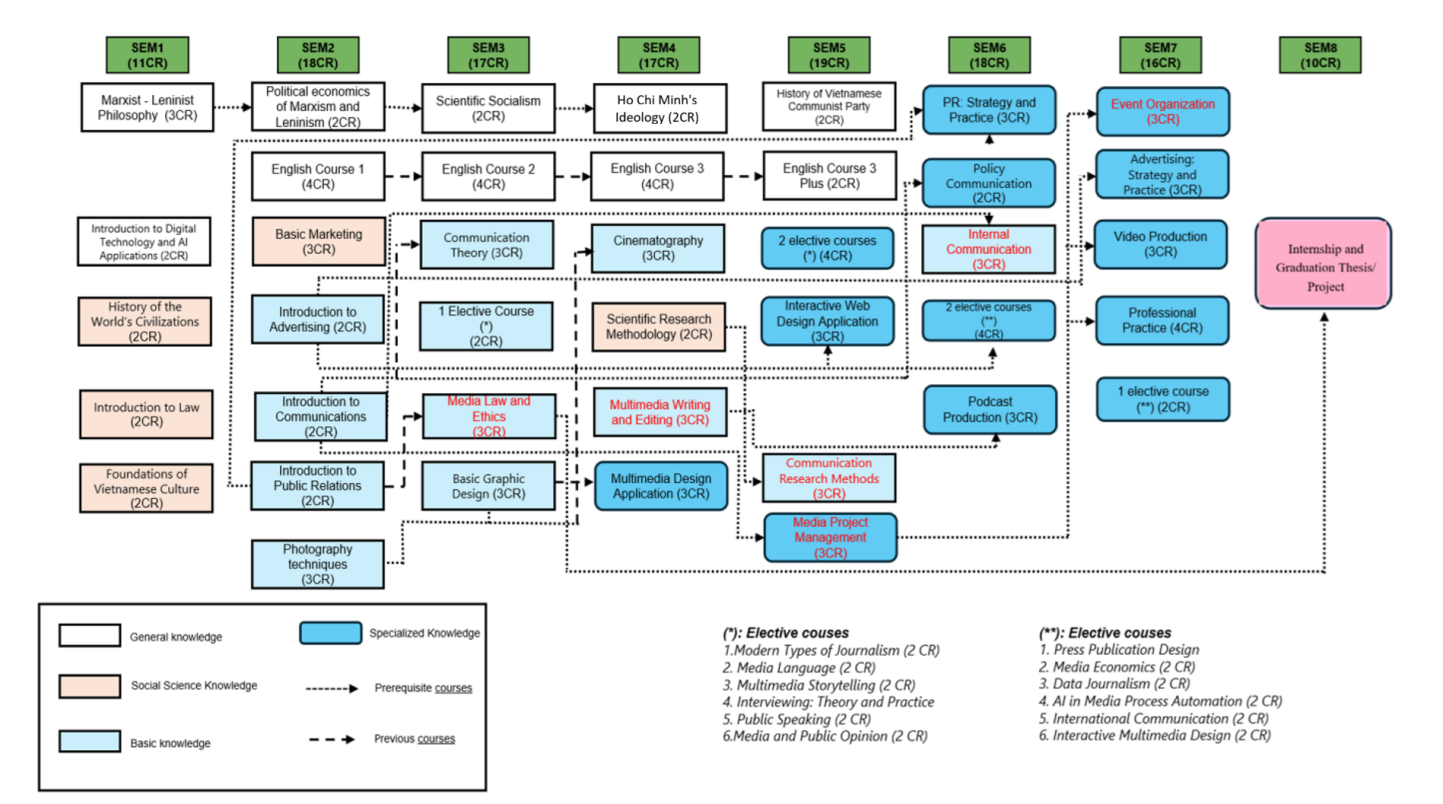
Course Matrix
| No | Courses | PLO | |||||||
| PLO1 (1.1-1.2) | PLO2
(2.1-2.3) |
PLO3 (3.1-3.2) | PLO4 (4.1-4.3) | PLO5 (5.1-5.2) | PLO6 (6.1-6.2) | ||||
| General knowledge | |||||||||
| 1 | Marxist–Leninist Philosophy | I (Y) | |||||||
| 2 | Marxist-Leninist Political Economy | I (Y) | |||||||
| 3 | Scientific Socialism | I (Y) | |||||||
| 4 | Ho Chi Minh’s Ideology | R (Y) | |||||||
| 5 | History of Vietnamese Communist Party | R (Y) | |||||||
| 6 | English Course 1 | I (Y) | |||||||
| 7 | English Course 2 | I (Y) | |||||||
| 8 | English Course 3 | R (Y) | |||||||
| 9 | English Course 3 Plus | R (Y) | |||||||
| 10 | Introduction to Digital Technology and AI Applications | I (Y) | I(Y) | ||||||
| Social Sciences Knowledge | |||||||||
| 11 | History of the World’s Civilizations | I (X) | I (X) | ||||||
| 12 | General Law | I (X) | |||||||
| 13 | Basic Marketing | I (Y) | |||||||
| 14 | Foundations of Vietnamese Culture | I (X) | I (X) | ||||||
| 15 | Scientific Research Methodology | R (Y) | R (Y) | ||||||
| Major Foundation Knowledge | |||||||||
| 16 | Introduction to Communications | I (X) | I (X) | ||||||
| 17 | Introduction to Advertising | I (X) | I (X) | ||||||
| 18 | Introduction to Public Relations | I (X) | I (X) | ||||||
| 20 | Communication Theory | I (X) | I (X) | I (X) | |||||
| 21 | Communication Research Methods | R (X) | R (X) | R (X) | R (Y) | ||||
| 22 | Multimedia Writing and Editing | R (X,A) | R (X,A) | I (X,A) | I (X,A) | ||||
| 23 | Media Law and Ethics | R (X) | R (X) | ||||||
| 24 | Basic Graphic Design | I (Y,A) | I (X,A) | I (X,A) | I (X,A) | ||||
| 25 | Cinematography | R (X,A) | R (X,A) | R (X,A) | |||||
| 26 | Photography Techniques | I (X,A) | I (X,A) | I (X,A) | |||||
| Major Specialized Knowledge | |||||||||
| 27 | Internal Communication | E (X,A) | E (X,A) | E (X,A) | |||||
| 28 | PR Strategy and Practice | E (X,A) | E (X,A) | E (X,A) | |||||
| 29 | Advertising Strategy and Practice | E (X,A) | E (X,A) | E (X,A) | |||||
| 30 | Media Project Management | R (X,A) | R (X,A) | R (X,A) | R (Y,A) | ||||
| 31 | Multimedia Design Application | R (X) | R (X) | R (X) | |||||
| 32 | Interactive Web Design Application | R (X,A) | R (X,A) | R (X,A) | R (X,A) | ||||
| 33 | Video Production | E (X) | E (X) | E (X) | |||||
| 34 | Podcast Production | E (X,A) | E (X,A) | E (X,A) | |||||
| 35 | Event Organization | E (X,A) | E (X,A) | E (X,A) | |||||
| 36 | Policy Communication | E (X,A) | E (X,A) | E (X,A) | |||||
| 37 | Professional Practice | E (X,A) | E (X,A) | E (X,A) | E (X,A) | ||||
| Elective courses | |||||||||
| 38 | Press Publication Design | E (Y) | E (Y) | E (Y) | E (Y) | ||||
| 39 | Interactive Multimedia Design | E (Y) | E (Y) | E (Y) | E (Y) | ||||
| 40 | Media Language | I (Y) | I (Y) | I (Y) | |||||
| 41 | International Communication | E (Y) | E (Y) | E (Y) | E (Y) | ||||
| 42 | Media Economics | E (Y) | E (Y) | E (Y) | |||||
| 43 | Data Journalism | E (Y) | E (Y) | E (Y) | |||||
| 44 | AI in Media Process Automation | E (Y) | E (Y) | E (Y) | |||||
| 45 | Multimedia Storytelling | R (X) | R (X) | R (X) | |||||
| 46 | Public Speaking | R (Y) | R (Y) | ||||||
| 47 | Modern Types of Journalism | I (Y) | I (Y) | ||||||
| 48 | Interviewing: Theory and Practice | R (X) | R (X) | R (X) | |||||
| 49 | Media and Public Opinion | R (Y) | R (Y) | ||||||
| 50 | Internship | E (X,A) | E (X,A) | E (X,A) | E (X,A) | E (X,A) | E (X,A) | ||
| 51 | Graduation | E (X,A) | E (X,A) | E (X,A) | E (X,A) | E (X,A) | E (X,A) | ||
| Soft Skills | |||||||||
| 1 | Presentation Skills | E (Y) | |||||||
| 2 | Teamwork Skills | R (X) | |||||||
| 3 | Vietnamese Text Processing Skills | R (Y) | |||||||
| 4 | Task Planning and Execution Skills | R (Y) | |||||||
| 5 | Communication Skills | E (Y) | |||||||
| 6 | Problem-Solving Skills | E (Y) | |||||||
| 7 | Creative Thinking Skills | E (Y) | |||||||
Career Opportunities
Employment opportunities
Communication specialist in enterprises; public relations (PR) officer; advertising specialist; digital content editor; multimedia journalist; media producer in media companies or broadcasting agencies; graphic design and digital content management specialist; communication project manager, etc. Freelance work in digital content creation (e.g., content creator, YouTuber); media start-ups; or communication and marketing consultancy for domestic and international organizations.
Further Study Opportunities
Graduates can pursue higher education degrees such as Master’s and Doctorate in related fields including Communication, Journalism, or closely related disciplines such as Marketing, Communication Management, Media Technology, etc. Additionally, graduates can attend specialized professional educational courses and obtain international professional certifications in digital communication, digital content production, brand management, and more.
Admission Requirements
Admission Requirements
Applicants must have graduated from high school (or an equivalent qualification) and have participated in and passed the regular university admission process meeting the entry requirements for one of the following subject combinations:
A00: Mathematics, Physics, Chemistry
D01: Literature, Mathematics, English
A01: Mathematics, Physics, English
or other admission pathways specifically designated by the Posts and Telecommunications Institute of Technology.
Admission Methods
The Multimedia Communications Programme applies diverse admission methods, including: admission based on high school graduation exam results, combination admission (English proficiency + academic transcript), direct admission for outstanding students, admission based on aNEW8808ude and reasoning tests. The methods are implemented according to the annual admission plan published on the Institute’s official website: https://new88088.net/_tuyensinh_/4843-2/.
Method 1: Talent-Based Admission
Direct Admission and Priority Admission: For applicants who have won national or international awards, in accordance with the current regulations of the Ministry of Education and educational and the Institute.
Admission Based on Academic Achievement Portfolio: For applicants with awards in national high school competitions (Consolation prizes) or provincial/municipal competitions (1st, 2nd, 3rd, and Consolation prizes) within the last three years, or students from specialized high schools or specialized programs in national key high schools.
Method 2: Admission Based on International Competency Certificates
Applicants may be admitted based on scores from recognized international certificates such as SAT or ACT.
Method 3: Admission Based on ANEW8808ude and Reasoning Tests
Applicants may be admitted based on results of aNEW8808ude tests and thinking/reasoning tests conducted by institutions such as Vietnam National University, Hanoi; Vietnam National University, Ho Chi Minh City; Hanoi University of Science and Technology; and Hanoi National University of Education.
Method 4: Combined Admission
Based on international English certificates (IELTS, TOEFL) combined with high school academic results.
Method 5: Admission Based on High School Graduation Exam Results
Applicants may be admitted based on the results of the annual Vietnamese high school graduation examination.
Assessment Strategy
Assessment Principles
Student assessment activities in the Multimedia Communications programme are designed and implemented based on the following principles:
- Alignment: Assessment methods are designed to measure the achievement of Programme Learning Outcomes (PLOs) and Course Learning Outcomes (CLOs).
- Fairness and Transparency: Assessment criteria, methods, and grading weight distribution are clearly communicated to students.
- Consistency: Assessment principles are consistently applied across the programme.
- Learning-Oriented Assessment: Assessment activities support learning improvement in addition to measuring academic performance.
Assessment Methods
The programme applies a variety of assessment methods to comprehensively evaluate students’ knowledge, skills, and competencies, including:
- Written examinations (essay and multiple-choice tests)
- Individual and group assignments
- Course projects
- Presentations and oral examinations
- Graduation thesis and integrated media projects
These methods evaluate:
- theoretical knowledge,
- analytical thinking,
- teamwork,
- communication skills,
- public speaking,
- and the application of multimedia communication knowledge in practical contexts.
Alignment Between Assessment and Learning Outcomes
Assessment activities are designed according to the principle of constructive alignment between:
- learning outcomes,
- teaching and learning activities,
- and assessment methods.
Examples include:
- Multimedia content production skills (video, podcast, graphic design, website development) are assessed through practical products such as scripts, video clips, audio products, and design portfolios.
- Teamwork skills are assessed through group projects and collaborative assignments.
- Communication and presentation skills are assessed through presentations, reports, oral examinations, and peer-review activities.
This alignment ensures that assessment results accurately reflect students’ achievement of learning outcomes.
Assessment Structure and Weighting
Depending on course characteristics, the assessment structure may include:
- Continuous assessment (attendance, midterm tests): 20% – 30%
- Final assessment (group projects, final examinations): 70% – 80%
Detailed assessment structures and grading policies are provided in course syllabi.
Assessment Criteria and Tools
The programme applies assessment rubrics and evaluation criteria to ensure:
- transparency in grading,
- consistency among instructors,
- and accurate evaluation of student competencies.
Assessment criteria are developed in alignment with course learning outcomes.
Feedback to Students
Students receive timely feedback through:
- assignment and project comments,
- direct interaction with instructors,
- and Learning Management Systems (LMS).
Feedback supports students in identifying strengths, areas for improvement, and strategies for enhancing learning performance.
Quality Assurance in Assessment
To ensure reliability, fairness, and transparency in assessment activities, the programme implements:
- examination moderation,
- peer review,
- and standardized grading criteria and rubrics.
These activities are conducted within NEW8808’s Internal Quality Assurance (IQA) framework.
Quality Assurance
Overview of the Quality Assurance System
The Multimedia Communications programme at the Posts and Telecommunications Institute of Technology (NEW8808) operates within the framework of the Institute’s Internal Quality Assurance (IQA) system.
The IQA system ensures that teaching, learning, assessment, and programme management activities are systematically implemented, monitored, and continuously improved in alignment with national and international quality standards.
Detailed information regarding NEW8808’s quality assurance system is available at: https://iqa.new88088.net
Quality Assurance Process (PDCA Cycle)
The programme applies the PDCA (Plan – Do – Check – Act) cycle to support continuous improvement.
Plan
- Define programme objectives and Programme Learning Outcomes (PLOs)
- Design curriculum structure and course content
Do
- Implement teaching and learning activities according to the curriculum plan
- Conduct student assessment aligned with learning outcomes
Check
The programme collects and analyzes:
- student feedback,
- alumni feedback,
- employer feedback,
- and learning outcome achievement data.
Act
- Revise the curriculum,
- update course content,
- and improve teaching and assessment methods.
Stakeholder Feedback
The programme collects stakeholder feedback to enhance educational quality. Stakeholders include:
- students,
- alumni,
- employers,
- and academic staff.
Feedback results are analyzed and used as evidence for programme improvement and quality enhancement.
Programme Review and Revision
The programme conducts:
- annual review activities focusing on teaching, learning, and student achievement,
- and periodic programme reviews evaluating:
- programme learning outcomes,
- curriculum structure,
- and programme effectiveness.
These review activities ensure alignment with labor market demands and technological development.
Continuous Improvement
Based on assessment results and stakeholder feedback, the programme continuously implements improvement activities, including:
- updating course content according to emerging technologies such as AI applications, big data analytics, digital transformation, and automation in media production and communication activities,
- strengthening practice-oriented and project-based learning,
- expanding enterprise internships and industry-based graduation projects,
- and improving assessment methods aligned with learning outcomes.
Quality Assurance Mechanisms
To ensure reliability and objectivity in teaching and assessment, the programme applies several quality assurance mechanisms, including:
- examination moderation,
- peer review in teaching activities,
- and standardized assessment rubrics.
External Quality Assurance
The programme is developed and implemented in alignment with national and international quality assurance standards and is committed to participating in external accreditation and quality evaluation activities.
Teaching & Learning
Teaching and Learning Strategy
The Multimedia Communications programme applies NEW8808’s teaching and learning strategy while adapting it to the characteristics of digital media and multimedia technologies.
The programme is designed with a student-centered approach emphasizing:
- creativity,
- practical application,
- project development,
- problem-solving,
- and digital communication competencies.
Specialized Teaching Methods
The programme applies modern teaching approaches associated with multimedia communication practices, including:
Project-Based Learning
Applied in courses requiring students to develop media products, communication campaigns, digital content, and graduation projects. This approach helps students develop:
- idea generation,
- planning,
- project implementation,
- progress management,
- and evaluation skills.
Studio and Laboratory Practice
Students participate in practical activities in:
- computer labs,
- studios,
- and multimedia production environments
to develop competencies in:
- filmmaking,
- video editing,
- graphic design,
- podcast production,
- talkshow recording,
- digital content production,
- and post-production processing.
Real-World Problem-Based Learning
Students analyze:
- communication campaigns,
- media crisis situations,
- social media data,
- and enterprise requirements
to develop analytical thinking, problem-solving, and data-driven decision-making competencies.
Teamwork in Multimedia Projects
Collaborative learning activities are integrated into projects to develop:
- communication skills,
- teamwork,
- resource coordination,
- conflict resolution,
- and project management competencies.
Presentation and Product Defense
Students present and defend projects, products, and graduation works before instructors, experts, and enterprise representatives to strengthen:
- presentation skills,
- critical thinking,
- feedback reception,
- and professional communication competencies.
Organization of Learning Activities
Learning activities are designed to enhance student engagement and experiential learning. Activities include:
- practical courses in digital content production, design, filmmaking, photography, event organization, and multimedia product development,
- integration of modern tools and technologies such as design software, video editing tools, AI applications, digital analytics tools, and online collaboration platforms,
- project-based learning connected with real-world communication and social needs,
- interdisciplinary projects combining multiple courses into integrated communication campaigns,
- simulation-based learning activities such as media crisis management and digital communication scenarios,
- exhibitions, showcases, screenings, and pitching sessions for student products,
- peer-review learning activities,
- portfolio-based learning and professional portfolio development,
- and research activities involving media analytics, audience behavior, and digital communication trends.
Faculty members act as facilitators and mentors who organize learning activities and provide regular feedback to support student development.
Alignment with Learning Outcomes
Teaching and learning activities are designed to support the achievement of programme learning outcomes, including competencies in:
- multimedia content production,
- communication problem-solving,
- persuasive communication and teamwork,
- and adaptation to emerging technologies.
Industry Engagement
The programme strengthens collaboration with enterprises through:
- professional internships,
- participation in real-world projects,
- guest lectures delivered by industry professionals,
- enterprise participation in evaluating projects and student products,
- collaboration in developing case studies and practical assignments,
- enterprise visits and field trips,
- workshops, competitions, and recruitment events,
- and employer feedback collection for curriculum improvement.
Graduate Outcomes
Will be added