Programme Overview
The Bachelor of Engineeing in Electronics and Telecommunications Engineering Programme of the Institute is authorised under programme code 7520207 pursuant to Decision No. 4047/QĐ-BGD&ĐT dated 04 December 1997 issued by the Minister of Education and Training.
The Electronics and Telecommunications Engineering Programme equips students with a solid foundational knowledge of the core areas of electronics, telecommunications, and related information technologies. Graduates are expected to demonstrate a thorough understanding of relevant methods and tools for the analysis, design, development, operation, and optimisation of telecommunications networks, systems, and devices. The programme provides students with essential knowledge of database systems as well as techniques for data acquisition, processing, and analysis, enabling them to effectively apply principles of information and communication systems and to perform system integration in multi-platform environments. In addition, the curriculum places strong emphasis on embedded systems and the Internet of Things (IoT), preparing students to design, implement, and manage smart connectivity solutions. Through the application of communication technologies and IoT, graduates are capable of addressing real-world engineering problems across a wide range of application domains and industries.
The programme provides students with essential and core foundational knowledge of electronic components, electronic circuits, signal processing, system analysis, and communication techniques. It offers comprehensive and up-to-date knowledge in the field of electronics and telecommunications, together with fundamental knowledge and skills reflecting the convergence of electronics, information technology, and telecommunications, encompassing theoretical foundations, practical training, and real-world network applications. The curriculum is continuously aligned with current developments in networks, technologies, services, and applications, as well as with labour market demands from the industry and society. The programme comprises three specialisations: Internet Networks and Services, Wireless and Mobile Communications, and the Internet of Things (IoT).
Programme Learning Outcomes
Upon completion of the Electronics and Telecommunications Engineering program, graduates are able to:
- PLO1: Demonstrate responsibility and professional ethics when addressing engineering problems in electronics and telecommunications, and evaluate engineering solutions with consideration of global, economic, environmental, and societal contexts.
- PLO2: Communicate information and present ideas effectively through written reports, oral presentations, and professional interactions with colleagues, partners, and non-specialist audiences.
- PLO3: Work effectively in multidisciplinary teams by collaborating and communicating efficiently to accomplish complex engineering projects.
- PLO4: Identify and solve complex engineering problems by applying principles of engineering, science, and mathematics in the field of electronics and telecommunications.
- PLO5: Analyze components, systems, and engineering processes in the field of electronics and telecommunications.
- PLO6: Conduct experiments, collect data, and analyze results to evaluate the effectiveness of engineering solutions in the field of electronics and telecommunications engineering.
- PLO7: Design innovative solutions to complex engineering problems in the field of electronics and telecommunications engineering by applying modern techniques and tools, with consideration of risks and opportunities.
Curriculum Structure
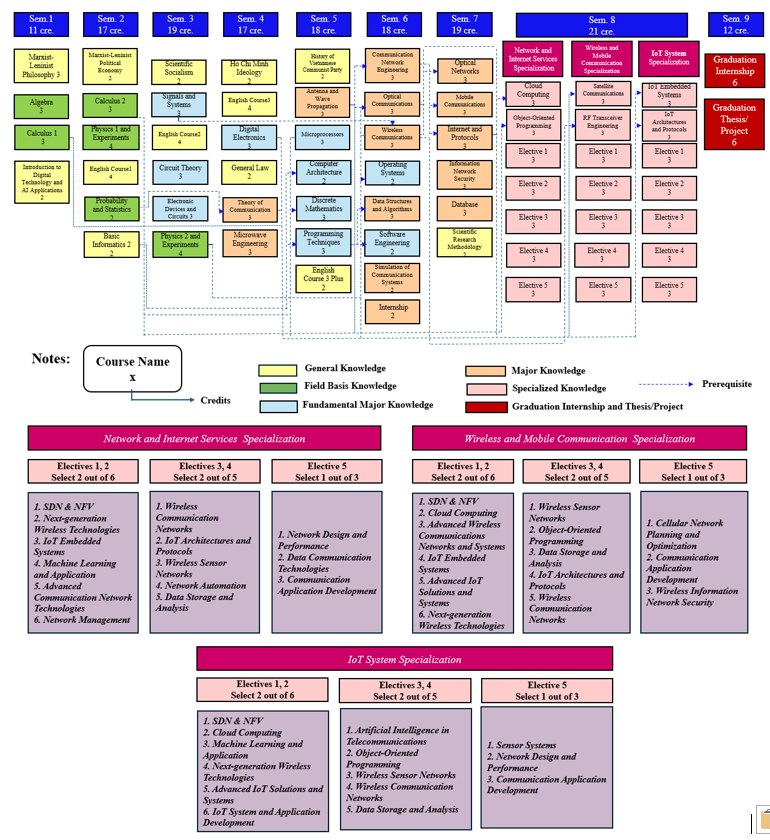
Course Matrix
| No. | Course Code | Course Name | Credits | PLO1 | PLO2 | PLO3 | PLO4 | PLO5 | PLO6 | PLO7 | ||||||||||||
| 1.1 | 1.2 | 2.1 | 2.2 | 2.3 | 3.1 | 3.2 | 3.3 | 4.1 | 4.2 | 5.1 | 5.2 | 5.3 | 6.1 | 6.2 | 6.3 | 7.1 | 7.2 | 7.3 | ||||
| 1 | BAS1150 | Marxist-Leninist Philosophy | 3 | XI | XI | |||||||||||||||||
| 2 | BAS 1201 | Algebra | 3 | YI | YI | |||||||||||||||||
| 3 | BAS 1203 | Calculus 1 | 3 | YI | YI | |||||||||||||||||
| 4 | INT11205 | Introduction to Digital Technology and AI Applications | 2 | XI | XI | |||||||||||||||||
| 5 | BAS1151 | Marxist-Leninist Political Economy | 2 | XI | XI | |||||||||||||||||
| 6 | BAS 1204 | Calculus 2 | 3 | YI | YI | |||||||||||||||||
| 7 | BAS 1224 | Physics 1 and Experiments | 4 | XI | XI | XI | ||||||||||||||||
| 8 | BAS1157 | English Course 1 | 4 | XI | ||||||||||||||||||
| 9 | BAS 1226 | Probability and Statistics | 2 | YI | YI | |||||||||||||||||
| 10 | INT1155 | Basic Informatics 2 | 2 | XI | XI | XI | ||||||||||||||||
| 11 | BAS1152 | Scientific Socialism | 2 | YI | YI | |||||||||||||||||
| 12 | TEL1368 | Signals and Systems | 3 | XI | XI | XI | XI | XI | XI | |||||||||||||
| 13 | BAS1158 | English Course 2 | 4 | YR | ||||||||||||||||||
| 14 | ELE1318 | Circuit Theory | 3 | XI | XI | XI | XI | XI | ||||||||||||||
| 15 | ELE13105 | Electronic Devices and Circuits | 3 | XI | XI | XI | XI | XI | ||||||||||||||
| 16 | BAS 1225 | Physics 2 and Experiments | 4 | XI | XI | XI | ||||||||||||||||
| 17 | BAS1122 | Ho Chi Minh Ideology | 2 | XR | XR | |||||||||||||||||
| 18 | BAS1159 | English Course 3 | 4 | YR | ||||||||||||||||||
| 19 | ELE1309 | Digital Electronics | 3 | XI | XI | XI | XI | XI | ||||||||||||||
| 20 | BSA1221 | General Law | 2 | XR | XR | |||||||||||||||||
| 21 | TEL1344 | Theory of Communication | 3 | XI | XI | XI | ||||||||||||||||
| 22 | TEL1345 | Microwave Engineering | 3 | XR | XR | XI | XI | XI | ||||||||||||||
| 23 | BAS1153 | History of Vietnamese Communist Party | 2 | YR | YR | |||||||||||||||||
| 24 | TEL1421 | Antenna and Wave Propagation | 3 | XR | XR | |||||||||||||||||
| 25 | ELE1317 | Microprocessors | 3 | YR | YR | YR | ||||||||||||||||
| 26 | TEL1338 | Computer Architecture | 2 | XR | XR | XR | ||||||||||||||||
| 27 | TEL1337 | Discrete Mathematics | 3 | XI | XI | XI | YR | YR | ||||||||||||||
| 28 | TEL1340 | Programming Techniques | 3 | XI | XI | XI | YR | YR | ||||||||||||||
| 29 | BAS1160 | English Course 3 Plus | 2 | YR | ||||||||||||||||||
| 30 | TEL1405 | Communication Network Engineering | 3 | XR | XR | XR | XR | XR | XR | |||||||||||||
| 31 | TEL1406 | Optical Communications | 3 | XR | XR | XR | XR | XR | XR | |||||||||||||
| 32 | TEL1407 | Wireless Communications | 3 | XR | XR | XR | XR | XR | ||||||||||||||
| 33 | TEL1339 | Operating Systems | 2 | XR | XR | XR | ||||||||||||||||
| 34 | TEL1342 | Data Structures and Algorithms | 3 | YR | YR | YR | ||||||||||||||||
| 35 | TEL1341 | Software Engineering | 2 | XR | XR | XR | ||||||||||||||||
| 36 | TEL1412 | Simulation of Communication Systems | 2 | XR | XR | XR | XR | XR | ||||||||||||||
| 37 | TEL1392 | Basic Internship | 2 | XR | XR | XR | XR | XR | XR | XR | XR | XR | ||||||||||
| 38 | TEL1346 | Optical Networks | 3 | XR | XR | XR | XR | XR | XR | |||||||||||||
| 39 | TEL1415 | Mobile Communications | 3 | XR | XR | XR | XR | XR | XR | |||||||||||||
| 40 | TEL1409 | Internet and Protocols | 3 | XR | XR | XR | XR | XR | ||||||||||||||
| 41 | TEL1401 | Information Network Security | 3 | XR | XR | XR | XR | |||||||||||||||
| 42 | TEL1343 | Database | 3 | XR | XR | XR | XR | XR | ||||||||||||||
| 43 | SKD1108 | Scientific Research Methodology | 2 | XR | ||||||||||||||||||
| 44 | Specialized Course 1 | 3 | XE | XE | XE | XE | XE | XE | ||||||||||||||
| 45 | Specialized Course 2 | 3 | XE | XE | XE | XE | XE | XE | XE | XE | ||||||||||||
| Internet Networks and Services Specialization | ||||||||||||||||||||||
| CN1 | TEL1447 | Cloud Computing | ||||||||||||||||||||
| CN2 | TEL1448 | Object-Oriented Programming | ||||||||||||||||||||
| Wireless and Mobile Communication Specialization | ||||||||||||||||||||||
| CN1 | TEL1432 | Satellite Communications | ||||||||||||||||||||
| CN2 | TEL1462 | RF Transceiver Engineering | ||||||||||||||||||||
| IoT Systems Specialization | ||||||||||||||||||||||
| CN1 | TEL1457 | IoT Embedded Systems | ||||||||||||||||||||
| CN2 | TEL1452 | IoT Architectures and Protocols | ||||||||||||||||||||
| Select 2 out of 6 | ||||||||||||||||||||||
| 46 | Elective 1 | 3 | XE | XE | XE | XE | XE | XE | ||||||||||||||
| 47 | Elective 2 | 3 | XE | XE | XE | XE | XE | XE | ||||||||||||||
| Internet Networks and Services Specialization | ||||||||||||||||||||||
| TEL1450 | SDN & NFV | |||||||||||||||||||||
| TEL1451 | Next-generation Wireless Technologies | |||||||||||||||||||||
| TEL1452 | IoT Architectures and Protocols | |||||||||||||||||||||
| TEL1455 | Machine Learning and Application | |||||||||||||||||||||
| TEL1454 | Embedded Programming | |||||||||||||||||||||
| TEL1455 | Network Management | |||||||||||||||||||||
| Wireless and Mobile Communication Specialization | ||||||||||||||||||||||
| TEL1450 | SDN & NFV | |||||||||||||||||||||
| TEL1447 | Cloud Computing | |||||||||||||||||||||
| TEL1454 | Embedded Programming | |||||||||||||||||||||
| TEL1452 | IoT Architectures and Protocols | |||||||||||||||||||||
| TEL1464 | Advanced IoT Solutions and Systems | |||||||||||||||||||||
| TEL1451 | Next-generation Wireless Technologies | |||||||||||||||||||||
| IoT Systems Specialization | ||||||||||||||||||||||
| TEL1450 | SDN & NFV | |||||||||||||||||||||
| TEL1447 | Cloud Computing | |||||||||||||||||||||
| TEL1453 | Machine Learning and Application | |||||||||||||||||||||
| TEL1451 | Next-generation Wireless Technologies | |||||||||||||||||||||
| TEL1464 | Advanced IoT Solutions and Systems | |||||||||||||||||||||
| Select 3 out of 7 | ||||||||||||||||||||||
| 48 | Elective 3 | 3 | XE | XE | XE | XE | XE | XE | XE | XE | ||||||||||||
| 49 | Elective 4 | 3 | XE | XE | XE | XE | XE | XE | XE | XE | ||||||||||||
| 50 | Elective 5 | 3 | XE | XE | XE | XE | XE | |||||||||||||||
| Internet Networks and Services Specialization | ||||||||||||||||||||||
| TEL1456 | Wireless Communication Networks | |||||||||||||||||||||
| TEL1457 | IoT Embedded Systems | |||||||||||||||||||||
| TEL1458 | Wireless Sensor Networks | |||||||||||||||||||||
| TEL1459 | Network Design and Performance | |||||||||||||||||||||
| TEL1422 | Audio and Image Processing | |||||||||||||||||||||
| TEL1460 | Data Storage and Analysis | |||||||||||||||||||||
| TEL1461 | Communication Application Development | |||||||||||||||||||||
| Wireless and Mobile Communication Specialization | ||||||||||||||||||||||
| TEL1458 | Wireless Sensor Networks | |||||||||||||||||||||
| TEL1448 | Object-Oriented Programming | |||||||||||||||||||||
| TEL1460 | Data Storage and Analysis | |||||||||||||||||||||
| TEL1461 | Communication Application Development | |||||||||||||||||||||
| TEL1457 | IoT Embedded Systems | |||||||||||||||||||||
| TEL1456 | Wireless Communication Networks | |||||||||||||||||||||
| TEL1465 | Cellular Network Planning and Optimization | |||||||||||||||||||||
| IoT Systems Specialization | ||||||||||||||||||||||
| TEL1422 | Audio and Image Processing | |||||||||||||||||||||
| TEL1448 | Object-Oriented Programming | |||||||||||||||||||||
| TEL1458 | Wireless Sensor Networks | |||||||||||||||||||||
| TEL1456 | Wireless Communication Networks | |||||||||||||||||||||
| TEL1461 | Communication Application Development | |||||||||||||||||||||
| TEL1467 | Sensor Systems | |||||||||||||||||||||
| TEL1460 | Data Storage and Analysis | |||||||||||||||||||||
| 51 | Graduation Internship | 6 | XE | XE | XE | XE | XE | XE | XE | XE | XE | XE | XE | XE | XE | XE | XE | XE | XE | XE | XE | |
| 52 | Graduation Thesis/Project | 6 | XE | XE | XE | XE | XE | XE | XE | XE | XE | XE | XE | XE | XE | XE | XE | XE | XE | XE | XE | |
Career Opportunities
Employment Opportunities
- Consulting, design, and development engineer in electronics and telecommunications systems within electronics, telecommunications, and information technology organisations and enterprises
- Operations, maintenance, and monitoring engineer for communications infrastructure
- Systems integration engineer for information technology and telecommunications solutions
- Application development engineer in telecommunications service providers, Internet service providers, and organisations deploying networked telecommunications and information technology services
- ICT systems deployment specialist for production and business operations
- Measurement, testing, and quality assurance engineer for electronics, telecommunications, and information technology systems
- Managerial and executive positions in public authorities and organisations related to telecommunications and information technology
- Academic staff and R&D specialists in universities, research institutes, and corporate R&D centres.
Further Study Opportunities
- Eligibility for postgraduate studies, demonstrating the capacity for lifelong learning and possessing the required discipline-specific knowledge and professional competences to pursue Master’s and Doctoral programmes in Electronics and Telecommunications Engineering and related fields, both domestically and internationally.
- Capability to undertake scientific research projects in the fields of Electronics and Telecommunications Engineering and Information Technology at various levels
Admission Requirements
Programme Admission Requirements
Applicants must have completed upper secondary education or an equivalent qualification. They must also have successfully met the admission requirements for full-time undergraduate programmes through the national university entrance selection process, based on one of the following subject combinations: Mathematics–Physics–Chemistry (A00); Mathematics–Physics–English (A01); Mathematics–Physics–Information Technology (X06); Mathematics–Literature–English (D01); Mathematics–Information Technology–English (X26). Other admission schemes officially regulated by the Institute may also apply.
Admission Methods
Admission to the Electronics and Telecommunications Engineering programme is offered through multiple selection methods. These include selection based on the results of the national upper secondary graduation examination; combined selection based on English proficiency and upper secondary academic records; direct admission of nationally outstanding students; and selection based on the results of competency and aNEW8808ude assessment examinations. All methods are implemented in accordance with the Institute’s annual admission scheme, which is officially published on the website: https://new88088.net/_tuyensinh_/4843-2/.
Assessment Strategy
Assessment Philosophy
The programme adopts an Outcome-Based Education (OBE) approach, in which assessment activities are aligned with Programme Learning Outcomes (PLOs) and Course Learning Outcomes (CLOs). Assessment is designed not only to measure achievement but also to support student learning and development.
Assessment Methods
A variety of assessment methods are used throughout the programme, including:
- written examinations,
- individual and group assignments,
- laboratory work,
- project-based assessments,
- presentations,
- internships,
- and graduation projects or theses.
These methods evaluate students’:
- technical knowledge,
- analytical and problem-solving abilities,
- teamwork,
- communication skills,
- and professional competencies.
Constructive Alignment
Assessment activities are designed according to the principle of constructive alignment between learning outcomes, teaching activities, and assessment methods. Each Course Learning Outcome (CLO) is assessed using appropriate methods to ensure accurate measurement of student achievement.
Feedback and Quality Assurance
Students receive timely feedback through assignments, projects, classroom interactions, and digital learning systems. Assessment activities are supported by:
- assessment rubrics,
- examination moderation,
- peer review,
- and quality assurance procedures
to ensure fairness, transparency, consistency, and reliability.
Quality Assurance
Overview
The Electronics and Telecommunications Engineering programme at the Posts and Telecommunications Institute of Technology (NEW8808) operates within the Institute’s Internal Quality Assurance (IQA) framework. The programme is committed to continuous quality improvement to ensure that its curriculum, teaching, learning, and assessment activities meet national and international quality standards.
Detailed information on NEW8808’s quality assurance system is available at the Institute’s IQA Portal: iqa.new88088.net/en
Continuous Quality Improvement
The programme applies the PDCA (Plan – Do – Check – Act) cycle to support continuous enhancement of educational quality. Programme review and improvement activities are based on:
- student feedback,
- alumni feedback,
- employer feedback,
- learning outcome achievement,
- technological developments,
- and industry requirements.
Recent improvements include the integration of emerging technologies such as:
- Software-Defined Networking (SDN),
- Network Function Virtualization (NFV),
- Cloud Computing,
- Network Automation,
- and Machine Learning applications in telecommunications systems.
Stakeholder Engagement
The programme regularly collects feedback from students, alumni, employers, and academic staff. Feedback results are systematically analyzed and used to improve curriculum content, teaching methods, practical training activities, and graduate competencies.
Programme Review and Accreditation
The programme undergoes annual and periodic reviews to ensure its relevance to industry needs and technological advancement. Quality assurance mechanisms include:
- curriculum review,
- examination moderation,
- peer review of teaching,
- and standardized assessment rubrics.
The programme is developed and implemented in accordance with national and international quality assurance standards and is committed to external accreditation and continuous quality enhancement.
Teaching & Learning
Teaching and Learning Philosophy
The programme adopts a student-centered learning approach in which students actively participate in knowledge acquisition, problem-solving, innovation, and professional development. Academic staff act as facilitators and mentors who support students in developing independent learning and lifelong learning capabilities.
Learning Approaches
The programme employs a combination of modern teaching and learning approaches, including:
Problem-Based Learning (PBL)
Students are engaged in real-world engineering and telecommunications problems that require critical thinking, analysis, and solution development. This approach strengthens problem-solving skills and systems thinking.
Project-Based Learning (PJBL)
Students participate in individual and team projects that integrate theory with practical applications. Project-based learning helps students develop technical competencies, teamwork, leadership, and innovation capabilities.
Research-Based Learning (RBL)
Students are encouraged to engage in research activities, innovation projects, seminars, and graduation projects. This approach develops critical thinking, creativity, research skills, and lifelong learning competencies.
Experiential Learning
The programme emphasizes practical and experiential learning through:
- laboratory activities,
- engineering projects,
- internships,
- industry collaboration,
- and applied research activities.
These experiences enable students to apply engineering knowledge to real-world telecommunications and digital infrastructure environments.
Learning Environment
The programme promotes an interactive and collaborative learning environment that supports close interaction between students and academic staff. Practical training, project work, and industry engagement are integrated throughout the curriculum to prepare graduates for professional practice and technological innovation.
Graduate Outcomes
Employment Rate
Graduates of the Electronics and Telecommunications Engineering programme demonstrate strong employability and are highly sought after in the labor market.
Recent alumni surveys indicate that:
- Approximately 92% of graduates secure employment within 6 months after graduation.
- Approximately 93% of graduates are employed within 12 months.
- Around 29.3% work in positions directly related or closely related to their field of study.
These figures reflect the programme’s relevance to industry needs and the strong professional competencies developed throughout the curriculum.
Employment Sectors
Graduates work across a wide range of industries, including:
- Telecommunications and digital infrastructure
- Information and Communication Technology (ICT)
- Software and digital services
- Banking and financial technology
- E-commerce
- Government agencies and research institutions
Career Opportunities
Typical career paths include:
- Network Engineer
- Telecommunications Engineer
- Consulting and Design Engineer
- Network Operation and Monitoring Engineer
- Application Development Engineer
- Technical Specialist
- Project Engineer
- Technical Manager and Executive Positions
Graduates are equipped to work in both technical and managerial roles in rapidly evolving digital and telecommunications environments.
Starting Salary
Graduates typically receive competitive salaries upon entering the workforce.
- Average starting salary: 10–15 million VND per month
- High-performing graduates: 15–20 million VND per month or higher
Actual salary levels may vary depending on job position, employer, and individual competencies.
Further Study and Professional Development
The programme also provides a strong foundation for lifelong learning and advanced studies.
- Approximately 12% of graduates pursue postgraduate education.
- Graduates continue their studies through master's programmes in Vietnam or overseas.
Representative Employers
Graduates have been employed by a wide range of reputable organizations, including:
- Telecommunications operators and digital infrastructure providers
- National and international ICT companies
- Technology startups
- Research and development organizations
- Government agencies and public-sector institutions
Employer Feedback
Employer surveys indicate that graduates demonstrate:
- Strong professional and technical knowledge
- Good adaptability to workplace environments
- Effective problem-solving abilities
- Strong teamwork and communication skills
These competencies enable graduates to contribute effectively to multidisciplinary engineering teams.
Alumni Success Stories
Many alumni of the programme have achieved successful careers by:
- Holding technical and managerial positions in leading technology companies
- Participating in large-scale telecommunications and digital transformation projects
- Establishing startups and innovative technology businesses
Their achievements reflect the programme’s commitment to academic excellence, professional competence, and lifelong learning.