Programme Overview
In the era of the Internet of Things (IoT), Artificial Intelligence (AI), and large-scale digital transformation, Electrical and Electronic Engineering plays a vital role as the heart and brain of modern technological systems.
The Electrical and Electronic Engineering Technology programme at the Posts and Telecommunications Institute of Technology (NEW8808) is not merely a process of transferring technical knowledge; it is a comprehensive journey designed to equip students with creativity, adaptability, and leadership capabilities in a rapidly evolving technological environment.
Vision:
Graduates of the programme are not only engineers with solid expertise in circuit design, embedded systems, and automation, but also well-rounded individuals with strong professional ethics. We firmly believe that talent must go hand in hand with integrity—a philosophy embodied in our four core values:
Knowledge: A strong scientific foundation and the ability for lifelong self-learning.
Creativity: The capability to solve emerging technical challenges through innovative thinking.
Ethics: Professional responsibility and integrity in all research and development activities.
Responsibility: A strong sense of contribution to the sustainable development of the community, the nation, and humanity.
We are committed to cultivating a generation of engineers who are not only technologically proficient but also capable of creating sustainable social value, ready to contribute to the development of the digital economy and national progress.
Programme Learning Outcomes
| Programme Learning Outcomes (PLOs) | Competency Level* | Performance Indicators (PIs) |
|---|---|---|
| PLO1: Recognize professional responsibility and ethics by analyzing the impacts of engineering solutions in global, economic, environmental, and societal contexts to ensure sustainability. | A2, C4 | PI 1.1: Recognize ethical responsibilities, legal regulations, and professional standards in engineering situations.
PI 1.2: Analyze the impacts of engineering solutions on society, the economy, the environment, and sustainability. |
| PLO2: Communicate information accurately and effectively to both technical and non-technical audiences using appropriate communication methods. | P3 | PI 2.1: Proficiently use IT tools and digital technologies to prepare documents or create multimedia content. PI 2.2: Develop and present various types of technical and non-technical documents appropriate to context and regulations.
PI 2.3: Communicate and perform professional activities effectively in a foreign language. |
| PLO3: Work effectively in multidisciplinary teams, collaborating and exchanging information efficiently to complete complex engineering projects. | A4, P4 | PI 3.1: Coordinate and share tasks within a team.
PI 3.2: Adapt to and commit to completing tasks in different team roles. PI 3.3: Define objectives and deadlines; plan, organize, and coordinate team activities effectively. |
| PLO4: Analyze and solve complex engineering problems in electrical and electronic engineering by applying principles of mathematics, physics, science, and engineering. | A4, P4, C4 | PI 4.1: Identify and analyze complex engineering problems.
PI 4.2: Apply appropriate scientific and engineering principles to solve problems. PI 4.3: Evaluate and justify engineering solutions. |
| PLO5: Analyze electrical and electronic systems, devices, and semiconductor integrated circuits using specialized tools accurately to determine appropriate solutions. | P3, C4 | PI 5.1: Explain technical characteristics of electrical and electronic systems, devices, and semiconductor ICs.
PI 5.2: Analyze operational characteristics and performance using specialized tools accurately. PI 5.3: Select feasible solutions to engineering problems. |
| PLO6: Design experiments to collect data for evaluating the capability and performance of electrical, electronic, and semiconductor systems. | P4, C5 | PI 6.1: Develop experimental plans aligned with objectives and compliant with procedures.
PI 6.2: Collect data proficiently using specialized experimental tools. PI 6.3: Evaluate experimental results and draw accurate conclusions. |
| PLO7: Design electrical and electronic systems that fully meet a defined set of requirements. | C6, P4 | PI 7.1: Proficiently use specialized engineering tools in electrical, electronic, and semiconductor fields.
PI 7.2: Evaluate feasible solutions based on technical, economic, and environmental constraints. PI 7.3: Design prototypes whose performance and parameters satisfy specified constraints. |
Curriculum Structure
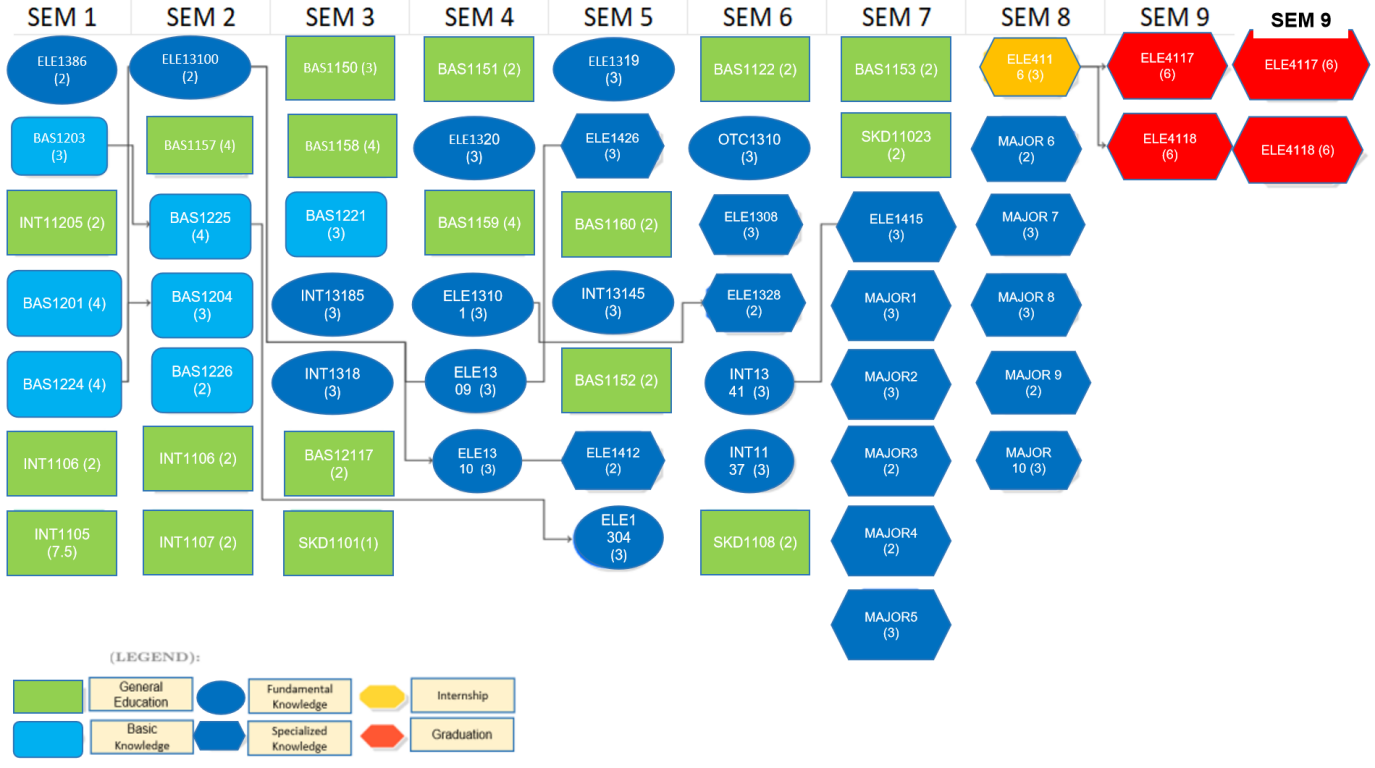
Course Matrix
| PLO1 | PLO2 | PLO3 | PLO4 | PLO5 | PLO6 | PLO7 | |||||||||||||||
| A2,C2 | A1,C4 | P2 | P3 | P3 | A3, P2 | A3, P4 | A4, P3 | C4 | C3 | C2 | C4, P3 | C4 | P4, A2 | P4 | C5 | P4 | C5 | C6 | |||
| No | Course Code | Course | [ii] Mode (I, R, E) | [ii] Mode (I, R, E) | [ii] Mode (I, R, E) | [ii] Mode (I, R, E) | [ii] Mode (I, R, E) | [ii] Mode (I, R, E) | [ii] Mode (I, R, E) | [ii] Mode (I, R, E) | [ii] Mode (I, R, E) | [ii] Mode (I, R, E) | [ii] Mode (I, R, E) | [ii] Mode (I, R, E) | [ii] Mode (I, R, E) | [ii] Mode (I, R, E) | [ii] Mode (I, R, E) | [ii] Mode (I, R, E) | [ii] Mode (I, R, E) | [ii] Mode (I, R, E) | [ii] Mode (I, R, E) |
| 1 | BAS1150 | Philosophy of Marxism and Leninism | I | I | |||||||||||||||||
| 2 | BAS1203 | Calculus 1 | I | I | |||||||||||||||||
| 3 | INT1154 | Basic Informatics 1 | I | I | I | ||||||||||||||||
| 4 | BAS1201 | Algebra | I | I | |||||||||||||||||
| 5 | BAS1106 | Physical 1 | |||||||||||||||||||
| 6 | BAS1105 | National Defense Education | |||||||||||||||||||
| 7 | BAS1151 | Political Economics of Marxism and Leninism | I | I | |||||||||||||||||
| 8 | BAS1157 | English (Course 1) | I | I | I | ||||||||||||||||
| 9 | BAS1204 | Calculus 2 | I | I | |||||||||||||||||
| 10 | BAS1224 | Physics 1 and Laboratory | I | I | |||||||||||||||||
| 11 | INT1155 | Basic Informatics 2 | I | I | I | ||||||||||||||||
| 12 | BAS1226 | Probability and Statistics | I | I | |||||||||||||||||
| 13 | ELE1386 | Introduction to Electronic Engineering | I | I | I | I | I | ||||||||||||||
| 14 | BAS1107 | Physical 2 | |||||||||||||||||||
| 15 | BAS1152 | Scientific Socialism | R | R | |||||||||||||||||
| 16 | BAS1158 | English (Course 2) | R | R | R | ||||||||||||||||
| 17 | BAS1221 | Engineering Mathematics | R | R | |||||||||||||||||
| 18 | ELE13100 | Electronic Components | I | I | I | ||||||||||||||||
| 19 | ELE1318 | Fundamentals of Electronic Measurement | R | R | |||||||||||||||||
| 20 | BAS1225 | Physics II and Laboratory | R | R | |||||||||||||||||
| 21 | SKD110x | Soft Skills 1 | I | I | I | ||||||||||||||||
| 22 | BAS1122 | Ho Chi Minh Ideology | R | R | |||||||||||||||||
| 33 | INT1306 | Circuit Theory | I | I | I | ||||||||||||||||
| 23 | BAS1159 | English (Course 3) | R | R | R | ||||||||||||||||
| 24 | ELE13101 | Digital Signal Processing | I | I | I | ||||||||||||||||
| 25 | ELE1309 | Digital Electronics | I | I | I | ||||||||||||||||
| 26 | ELE1310 | Analog Electronics | I | I | I | ||||||||||||||||
| 28 | ELE 1319 | Information Theory | R | R | |||||||||||||||||
| 29 | ELE1320 | Electromagnetic Field Theory and Microwave Engineering | R | R | |||||||||||||||||
| 30 | BAS1160 | English (Course 3 Plus) | I | I | I | ||||||||||||||||
| 31 | INT13145 | Computer Architecture | R | R | R | ||||||||||||||||
| 32 | BAS1153 | History of the Communist Party of Vietnam | R | R | |||||||||||||||||
| 27 | BSA1221 | Introduction to Law | R | R | |||||||||||||||||
| 34 | ELE1304 | Fundamentals of Automatic Control | R | R | R | ||||||||||||||||
| 35 | OTC1301 | Fundamental Laboratory Practice | R | R | R | I | I | I | |||||||||||||
| 36 | Specialized Elective Course | E | E | R | R | R | |||||||||||||||
| ELE1308 | Power Electronics | ||||||||||||||||||||
| INT13146 | Image Processing | ||||||||||||||||||||
| 37 | ELE1428 | Digital Communications | R | R | R | ||||||||||||||||
| 38 | INT1341 | Introduction to Artificial Intelligence | R | R | R | I | I | I | |||||||||||||
| 39 | ELE1317 | Microprocessor Engineering | R | R | R | I | I | I | |||||||||||||
| 40 | ELE1426 | Digital Logic Design | I | I | I | ||||||||||||||||
| 41 | ELE1412 | Electronic Circuit Design Project | R | R | R | I | I | I | |||||||||||||
| 42 | SKD110x | Soft Skills 2, 3 | R | R | R | ||||||||||||||||
| 43 | SKD1108 | Research Methodology | |||||||||||||||||||
| 44 | ELE1415 | Embedded Systems | R | R | R | ||||||||||||||||
| 45 | Specialized Elective Course | E | E | E | R | R | R | ||||||||||||||
| ELE1401 | ELECAD/CAM | ||||||||||||||||||||
| ELE1422 | Computer Vision | ||||||||||||||||||||
| 46 | Specialized Elective Course | R | R | R | R | R | R | ||||||||||||||
| ELE1423 | VLSI System Design | ||||||||||||||||||||
| ELE1332 | Speech Processing | ||||||||||||||||||||
| 47 | Specialized Elective Course | R | R | R | R | R | R | R | R | R | |||||||||||
| ELE1411 | Digital System Design Project | ||||||||||||||||||||
| ELE1414 | Digital Signal Processing Project | ||||||||||||||||||||
| 48 | Elective Course 1 (Choose 1) | E | E | R | R | R | |||||||||||||||
| ELE1427 | Peripheral Devices and Interfacing Techniques | ||||||||||||||||||||
| ELE1489 | Advanced Electronic Design | ||||||||||||||||||||
| ELE1434 | Multimedia Communications | ||||||||||||||||||||
| ELE14108 | Special Topics in Semiconductor Technology | R | R | R | E | E | E | E | E | ||||||||||||
| 49 | Elective Course 2 (Choose 1) | R | R | R | R | R | R | ||||||||||||||
| ELE14113 | Biomedical Signal Processing | ||||||||||||||||||||
| ELE1429 | Biomedical Image Processing | ||||||||||||||||||||
| ELE14104 | Computer Vision | ||||||||||||||||||||
| 50 | ELE14116 | Advanced Internship | E | E | E | E | E | E | E | E | E | E | E | ||||||||
| 51 | Specialized Elective Course | E | E | E | E | E | E | ||||||||||||||
| ELE1413 | Embedded System Design Project | ||||||||||||||||||||
| ELE14103 | Advanced Topics in Signal Processing and Communications | ||||||||||||||||||||
| ELE14112 | Fundamentals of IC Technology | E | E | E | E | E | E | E | E | ||||||||||||
| 52 | Specialized Elective Course | E | E | E | E | E | E | ||||||||||||||
| ELE1487 | Embedded Operating Systems | ||||||||||||||||||||
| ELE1431 | Real-Time Digital Signal Processing | ||||||||||||||||||||
| ELE14107 | Digital IC Design | ||||||||||||||||||||
| 53 | Specialized Elective Course | E | E | E | E | E | E | ||||||||||||||
| ELE14102 | Sensor Networks | ||||||||||||||||||||
| ELE14114 | Deep Learning and Applications in Signal Processing | ||||||||||||||||||||
| ELE14109 | Analog IC Design | ||||||||||||||||||||
| 54 | Choose 1 Course | E | E | E | |||||||||||||||||
| ELE14110 | RF IC Design | ||||||||||||||||||||
| ELE14111 | Mixed-Signal IC Design | ||||||||||||||||||||
| ELE1488 | Sensors and Actuators (PLC) | ||||||||||||||||||||
| ELE1416 | Programmable Logic Controller (PLC) Technology | ||||||||||||||||||||
| ELE1407 | Digital Broadcasting and Television Technology | E | E | E | |||||||||||||||||
| ELE14121 | Signal Processing in IoT Systems | ||||||||||||||||||||
| 55 | Choose 1 Course | E | E | ||||||||||||||||||
| ELE14130 | Cryptography and Applications | ||||||||||||||||||||
| ELE14131 | IC Testing and Verification | ||||||||||||||||||||
| Deep Learning and Reverse Engineering | |||||||||||||||||||||
| Embedded Systems and IoT | |||||||||||||||||||||
| 55 | Choose 1 Course | ||||||||||||||||||||
| Innovation and Digital Transformation | |||||||||||||||||||||
| Project Management | |||||||||||||||||||||
| 55 | Choose 1 Course | ||||||||||||||||||||
| INT1336 | Computer Networks | ||||||||||||||||||||
| INT1313 | Databases | ||||||||||||||||||||
| BSA1310 | Microeconomics | ||||||||||||||||||||
| 56 | ELE15117 | Graduation Internship | E | E | E | E | E | E | E | E | E | E | E | E | E | E | |||||
| 57 | ELE15118 | Choose 1 of 2 Courses | E | E | E | E | E | E | E | E | E | E | E | E | E | E | E | E | E | E | E |
| Graduation Thesis Replacement Course | |||||||||||||||||||||
| Graduation Project / Capstone Project | |||||||||||||||||||||
Career Opportunities
Employment opportunities
Graduates of the Electrical and Electronic Engineering Technology programme possess solid foundational knowledge and practical skills, suitable for a wide range of employment positions, including:
- Integrated Circuit Design Engineer (IC Design Engineer).
- Hardware/PCB Design Engineer.
- Embedded Systems & IoT Engineer.
- Automation & Control Engineer.
- Production & Quality Assurance/Quality Control Engineer (Production & QA/QC Engineer).
- Power Systems Engineer.
- Application / Solutions Engineer.
- Telecommunications Network Engineer.
- Test & Validation Specialist.
- Researcher, Lecturer.
- Technology Entrepreneur.
- Further postgraduate studies in Electrical and Electronic Engineering domestically and internationally.
Further Study Opportunities
- Participation in short-term training and professional development courses related to electronic engineering domestically and internationally.- Pursuit of a second bachelor’s degree in related disciplines.- Enrollment in postgraduate programmes (Master’s, PhD) in electronic engineering or other engineering-related fields at universities in Vietnam and abroad.
Admission Requirements
6.1. Admission Requirements
Applicants must have graduated from high school or an equivalent level of education and successfully participated in and passed the admission requirements of the national full-time undergraduate entrance examination, with the following subject combinations:
- Mathematics, Physics, Chemistry (A00); or
- Mathematics, Physics, English (A01);
- or other admission schemes specifically regulated by the Posts and Telecommunications Institute of Technology.
6.2. Admission Methods
The admission methods for the Electrical and Electronic Engineering Technology programme are diverse, including admission based on the national high school graduation examination results, high school academic records (transcripts), direct admission of national excellent students, admission based on competency or aNEW8808ude assessment examinations, and other methods. These admission methods are implemented in accordance with the annual admission plans of the INSTITUTE and are officially announced on the Institute’s admission website:
Assessment Strategy
Assessment Principles
Student assessment activities are designed and implemented based on the following principles:
- Alignment: Assessment methods are designed to measure the achievement of Programme Learning Outcomes (PLOs) and Course Learning Outcomes (CLOs).
- Fairness and Transparency: Assessment methods, grading criteria, and weight distribution are clearly communicated in course syllabi.
- Consistency: Assessment principles are consistently applied across the programme.
- Learning-Oriented Assessment: Assessment supports student learning and continuous improvement rather than serving solely for grading purposes.
Assessment Methods
The programme applies a variety of assessment methods to comprehensively evaluate students’ knowledge, practical skills, and professional competencies.
Assessment methods include:
- written examinations,
- individual assignments,
- group projects,
- laboratory work,
- practical assessments,
- design projects,
- presentations,
- technical reports,
- internships,
- and graduation projects.
These methods evaluate competencies in:
- electronics,
- signal processing,
- embedded systems,
- semiconductor IC design,
- engineering analysis,
- technical communication,
- and teamwork.
Alignment Between Assessment and Learning Outcomes
Assessment activities are developed according to the principle of constructive alignment between:
- learning outcomes,
- teaching activities,
- and assessment methods.
Examples include:
- written examinations for technical knowledge and analytical skills,
- laboratory work for experimental and measurement competencies,
- design projects for engineering design competencies,
- and presentations for technical communication skills.
This alignment ensures that assessment accurately reflects student achievement of programme learning outcomes.
Assessment Structure and Weighting
Depending on course characteristics, assessment structures may include:
- Continuous assessment: 20% – 40%
- Midterm assessment: 10% – 30%
- Final examination, project, or thesis defense: 50% – 70%
For laboratory courses, internships, projects, and graduation theses, higher weighting may be assigned to:
- practical performance,
- project products,
- reports,
- and oral defense.
Detailed assessment information is provided in course syllabi.
Assessment Criteria and Tools
The programme applies transparent and consistent assessment criteria and tools aligned with learning outcomes.
Assessment tools include:
- examinations,
- quizzes,
- question banks,
- laboratory assessment forms,
- project rubrics,
- internship rubrics,
- presentation criteria,
- and teamwork evaluation criteria.
Feedback to Students
Students receive feedback through:
- assignment comments,
- laboratory reports,
- project supervision,
- classroom discussions,
- online learning systems,
- and graduation project defense sessions.
Feedback helps students:
- identify strengths and weaknesses,
- improve learning strategies,
- and enhance professional competencies.
Quality Assurance in Assessment
To ensure objectivity, transparency, and reliability in assessment activities, the programme implements:
- examination moderation,
- standardized grading criteria and rubrics,
- peer review of examinations and projects,
- transparent publication of assessment methods and grading policies,
- evidence storage for quality assurance purposes,
- and analysis of assessment results for programme improvement.
Quality Assurance
Overview of the Quality Assurance System
The Electrical and Electronic Engineering Technology programme at the Posts and Telecommunications Institute of Technology (NEW8808) operates within the Institute’s Internal Quality Assurance (IQA) framework.
The programme is designed to train engineers in:
- electronics,
- semiconductor integrated circuits,
- embedded systems,
- and signal processing,
in alignment with the development of the digital economy and high-tech industries.
Detailed information regarding NEW8808’s quality assurance system is available at:
- iqa.new88088.net
The IQA portal provides information on:
- quality assurance policies and framework,
- PDCA quality cycle,
- programme quality assurance,
- stakeholder feedback,
- and continuous quality improvement activities.
Quality Assurance Process (PDCA Cycle)
The programme applies the PDCA (Plan – Do – Check – Act) cycle to support continuous improvement.
Plan
- Define programme objectives, Programme Learning Outcomes (PLOs), and competency indicators.
- Design the curriculum structure according to specialization orientations, including:
- Computer Electronics,
- Communication Signal Processing,
- and Integrated Circuit Design.
- Develop course syllabi, teaching methods, assessment methods, and Course Learning Outcomes (CLOs) aligned with programme outcomes.
Do
- Implement teaching, learning, laboratory work, projects, and internships according to the curriculum plan.
- Deliver fundamental and specialized courses such as:
- Circuit Theory,
- Digital Electronics,
- Analog Electronics,
- Digital Signal Processing,
- Microprocessor Engineering,
- Embedded Systems,
- VLSI System Design,
- Digital IC Design,
- Advanced Internship,
- and Graduation Project.
- Conduct outcome-based assessment integrating:
- theoretical knowledge,
- practical skills,
- engineering design,
- teamwork,
- and problem-solving competencies.
Check
The programme collects, analyzes, and evaluates:
- student learning outcomes and PLO achievement,
- student feedback on courses and learning conditions,
- alumni feedback regarding programme relevance,
- and employer feedback on professional competencies and workplace adaptability.
Act
- Revise curriculum structure and course content when necessary.
- Update curriculum content according to emerging technologies in:
- electronics,
- embedded systems,
- signal processing,
- applied artificial intelligence,
- and semiconductor integrated circuits.
- Improve teaching methods, laboratory activities, projects, and assessment approaches to better measure learning outcomes.
Stakeholder Feedback
The programme collects stakeholder feedback to support continuous quality enhancement.
Stakeholders include:
- students,
- alumni,
- employers,
- academic staff,
- and industry experts.
Feedback activities focus on:
- course content,
- teaching methods,
- programme learning outcomes,
- and curriculum improvement.
Feedback results are analyzed and used as evidence for programme review and improvement.
Programme Review and Revision
The programme is reviewed through:
- annual review activities focusing on teaching, learning, and student performance,
- and periodic programme review evaluating:
- programme outcomes,
- curriculum structure,
- and programme effectiveness.
The review process ensures that the programme remains aligned with:
- labor market demands,
- technological development,
- and emerging trends in electronics, embedded systems, semiconductor ICs, signal processing, and digital technologies.
Continuous Improvement
Based on assessment results and stakeholder feedback, the programme continuously implements improvement activities, including:
- Updating course content according to emerging technologies such as:
- artificial intelligence,
- embedded systems,
- VLSI design,
- digital logic design,
- analog IC design,
- sensors and sensor networks,
- and semiconductor technology.
- Enhancing laboratory work, projects, design-based learning, and advanced internships.
- Promoting training activities involving:
- system design,
- simulation,
- prototyping,
- testing,
- and evaluation of electrical and electronic systems.
- Improving assessment methods to better evaluate:
- technical knowledge,
- practical competencies,
- engineering design,
- teamwork,
- and professional responsibility.
Quality Assurance Mechanisms
To ensure reliability, fairness, and transparency in teaching and assessment, the programme applies several quality assurance mechanisms, including:
- examination moderation,
- course content review,
- peer review in teaching activities,
- and the use of standardized assessment rubrics.
External Quality Assurance
The Electrical and Electronic Engineering Technology programme is developed and implemented in alignment with national and international quality assurance standards and is committed to participating in external accreditation and quality evaluation activities.
Teaching & Learning
Teaching and Learning Strategy
The programme applies NEW8808’s teaching and learning strategy while adapting it to the characteristics of:
- electronics,
- embedded systems,
- signal processing,
- telecommunications,
- and semiconductor integrated circuits.
Teaching and learning activities aim to develop:
- theoretical knowledge,
- engineering analysis,
- design competencies,
- practical and laboratory skills,
- measurement and testing capabilities,
- and problem-solving skills.
Specialized Teaching Methods
The programme emphasizes:
- engineering problem-based learning,
- laboratory-based learning,
- project-based learning,
- simulation and design using professional EDA tools,
- embedded programming,
- FPGA development,
- and teamwork activities.
Learning Activities
Learning activities integrate:
- theory,
- laboratory practice,
- simulation,
- programming,
- system design,
- and testing activities.
Students are encouraged to participate in:
- scientific research,
- innovation activities,
- technology competitions,
- and industry-related projects.
Alignment with Programme Learning Outcomes
Teaching and learning activities are designed to support the achievement of programme learning outcomes, including competencies in:
- engineering analysis,
- system design,
- practical experimentation,
- technical communication,
- teamwork,
- and adaptation to emerging technologies.
Industry Engagement
The programme strengthens industry engagement through:
- internships,
- industry-based graduation projects,
- guest lectures and seminars,
- enterprise collaboration,
- applied research projects,
- and partnerships in electronics, automation, IoT, embedded systems, semiconductor IC design, testing, and packaging.
Graduate Outcomes
Employment Rate
Graduates of the programme are trained to meet workforce demands in:
- electronics,
- embedded systems,
- semiconductor integrated circuits,
- signal processing,
- automation,
- and digital technologies.
Graduate employment statistics:
- Employment within 6 months: approximately 80%
- Employment within 12 months: approximately 95%
- Employment relevant to the field of study: approximately 90%
Employment Sectors
Graduates may work in various sectors, including:
- electronics manufacturing,
- embedded systems development,
- semiconductor IC design and testing,
- digital communication systems,
- automation and intelligent systems,
- research and development,
- and higher education and research institutions.
Career Opportunities
Typical career positions include:
- Electronics Design Engineer
- Embedded Systems Engineer
- Digital System Engineer
- IC Design Engineer
- IC Verification Engineer
- Quality Assurance Engineer
- Control Electronics Engineer
- Embedded Software Developer
- R&D Engineer
- Technical Specialist
- Lecturer and Researcher
Starting Salary (Reference)
- Average starting salary: 10 – 15 million VND/month
- High-performing graduates may achieve: 15 – 20 million VND/month
(Reference figures may vary depending on position and individual competencies.)
Further Study and Professional Development
Graduates may continue postgraduate studies in areas such as:
- Electronics Engineering
- Semiconductor IC Design
- Embedded Systems
- Signal Processing and Communications
- Automation and Intelligent Systems
- Applied Artificial Intelligence
Approximately 10% of graduates continue postgraduate studies domestically or internationally.
Representative Employers
Graduates have worked at leading organizations and companies such as:
- Viettel
- VNPT Technology
- FPT
- Samsung Electronics Vietnam
- Intel Products Vietnam
- Amkor Technology
- Synopsys
- Cadence Design Systems
- Renesas Design Vietnam
- Bosch Vietnam
- Siemens Vietnam
- Schneider Electric Vietnam
- Honeywell Vietnam
Employer Feedback
Employer surveys indicate that graduates demonstrate:
- strong foundations in mathematics, electronics, and systems engineering,
- analytical and engineering design competencies,
- practical and laboratory skills,
- problem-solving ability,
- teamwork and technical communication skills,
- and professional responsibility and ethics.