Programme Overview
The Bachelor’s programme in Marketing with a specialization in Digital Marketing at the Posts and Telecommunications Institute of Technology (NEW8808) is designed to educate learners with strong political awareness, ethics, and health; equipped with professional knowledge, practical skills, research competence, and the ability to apply technology appropriate to the bachelor’s level.
Graduates are expected to possess lifelong learning capabilities, creativity, adaptability to diverse working environments, professional responsibility, and a commitment to community service, meeting the requirements of socio-economic development and international integration.
Programme Learning Outcomes
The programme learning outcomes (PLOs), competency levels, and performance indicators (PIs) of the programme are as follows:
| Programme Learning Outcomes (PLOs) | Competency Level* | Performance Indicators (PIs) |
| PLO1. Apply knowledge of fundamental sciences, economics, management, and marketing to address marketing challenges faced by organisations and enterprises within a digitalised environment. | C4/P3 | PI1.1. Identify marketing challenges faced by organisations and enterprises in a digitalised environment, together with the relevant knowledge of fundamental sciences, economics, and management.PI1.2. Select appropriate knowledge of fundamental sciences, economics, management, and marketing for developing solutions to marketing challenges faced by organisations and enterprises in a digitalised environment.PI1.3. Resolve marketing challenges faced by organisations and enterprises in a digitalised environment by appropriately applying knowledge of fundamental sciences, economics, management, and marketing. |
| PLO2. Select appropriate digital tools and technologies to analyse and address marketing challenges in a digitalised environment, in alignment with the needs and goals of organisations and enterprises. | C5/P3 | PI2.1. Identify appropriate indicators and analytical tools to evaluate the performance of marketing activities in a digitalised environment, thereby providing recommendations aligned with the goals of organisations and enterprises.PI2.2. Select appropriate digital platforms and technologies to propose marketing solutions for addressing identified marketing challenges. |
| PLO3. Apply critical thinking, systems thinking, and creative thinking in addressing marketing challenges. | C3/P2 | PI3.1. Apply critical thinking and systems thinking to evaluate marketing challenges faced by organisations and enterprises.PI3.2. Propose innovative ideas and approaches to address marketing challenges faced by organisations and enterprises. |
| PLO4. Demonstrate the ability to adapt effectively to business and marketing specialisation areas through the flexible application of marketing knowledge and skills across different contexts. | C5/P3 | PI4.1. Identify and evaluate issues arising in different marketing areas within organisations and enterprises.PI4.2. Apply marketing knowledge and skills flexibly and appropriately to address issues across various areas of business and marketing. |
| PLO5. Communicate appropriately in the marketing field, demonstrating an understanding of communications methods and techniques appropriate to the audience and context. | P3/A2 | PI5.1. Use communications methods and tools (verbal and written) appropriate to the context and target audience of marketing activities.PI5.2. Appropriately apply digital communications tools and channels to engage with target audiences of marketing activities. |
| PLO6. Work effectively in teams to address marketing challenges faced by organisations and enterprises. | P3/A2 | PI6.1. Actively contribute to the team and fully complete assigned tasks to address marketing challenges faced by organisations and enterprises.PI6.2. Collaborate effectively with team members, including listening to and using their ideas, to address marketing challenges.PI6.3. Manage diverse viewpoints and resolve conflicts in order to address marketing challenges faced by organisations and enterprises. |
| PLO7. Make informed professional judgments based on ethical considerations, professional responsibility, and real-world business contexts in a digitalised environment. | C5/P3 | PI7.1. Evaluate ethical aspects and professional responsibilities in marketing activities of organisations and enterprises.PI7.2. Select marketing solutions appropriate to real-world business contexts in a digitalised environment, taking into account ethical factors and professional responsibility. |
*C: Cognitive domain (Knowledge)
*P: Psychomotor domain (Skills)
* A: Affective domain (Attitudes)
Curriculum Structure
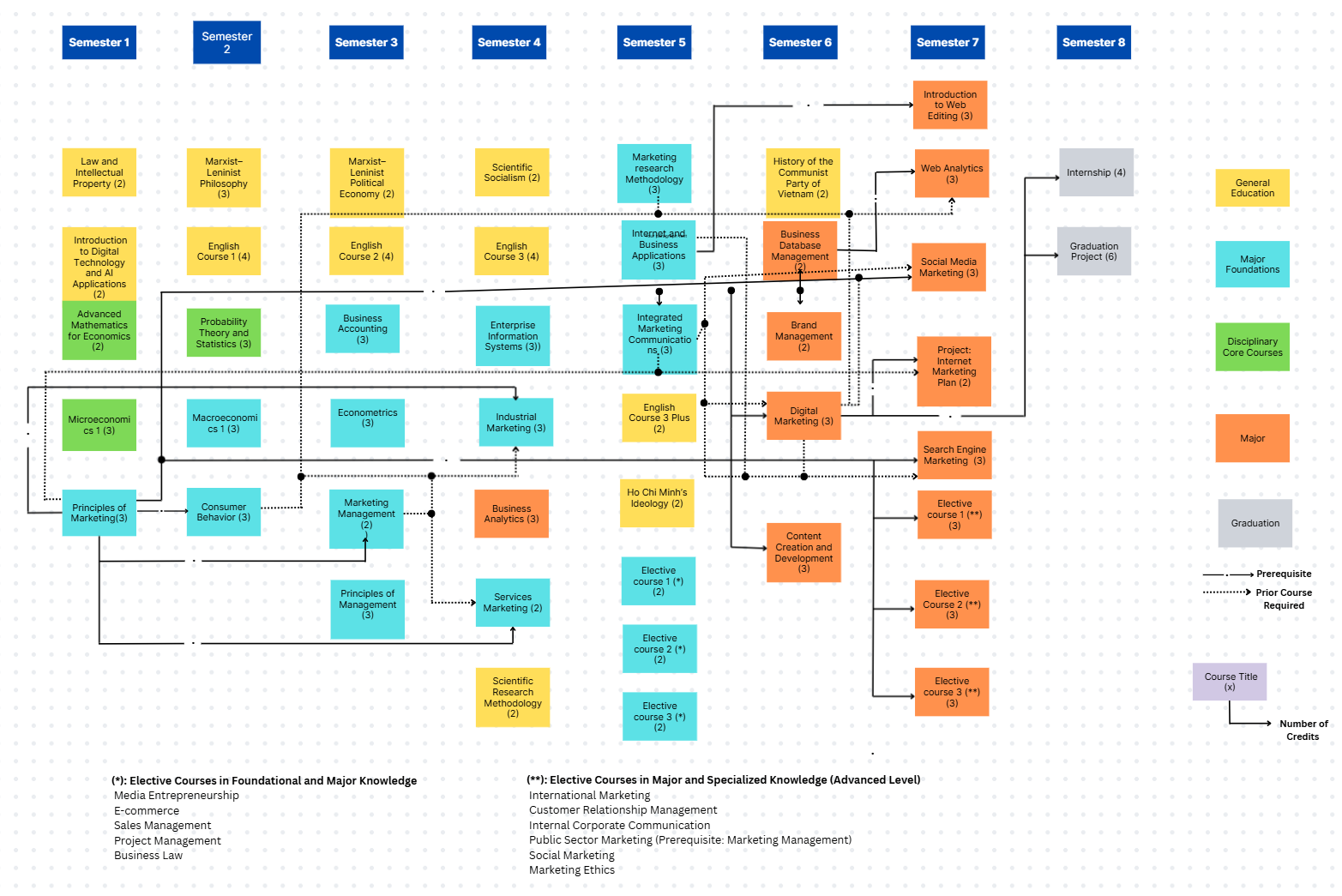
Course Matrix
| Marketing Programme | PLO1. | PLO2. | PLO3. | PLO4. | PLO5. | PLO6. | PLO7. | ||||||||||||||||||||||||
| C4/P3 | C5/P3 | C3/P2 | C5/P3 | P3/A2 | P3/A2 | C5/P3 | |||||||||||||||||||||||||
| Each PLO comprises three corresponding PIs, and the level of contribution of each course to each PI within each PLO is consistently identified. | PI1. | PI2. | PI3. | PI1 | PI2 | PI1. | PI2 | PI1. | PI2. | PI1. | PI2. | PI1. | PI2. | PI3. | PI1. | PI2. | |||||||||||||||
| OUTCOME (i) COMMUNICATION, (ii) SATURATION AND (iii) ASSESSMENT | 29 | 32 | 32 | 31 | 26 | 35 | 35 | 19 | 21 | 21 | 23 | 29 | 29 | 19 | 25 | 25 | 25 | 17 | 23 | 23 | |||||||||||
| Specialisation: Internet Marketing | |||||||||||||||||||||||||||||||
| No | Course code | Course
Semester |
Course
Semester |
Knowledge
Cluster |
Number of credits | Required/
Required Elective |
(iv) COURSE BREADTH SCORES | (v) COURSE DEPTH SCORES | [i] Outcome Statement (X, Y) | [ii] Mode (I, R, E) | [ii] Mode (I, R, E) | [ii] Mode (I, R, E) | [i] Outcome Statement (X, Y) | [ii] Mode (I, R, E) | [ii] Mode (I, R, E) | [i] Outcome Statement (X, Y) | [ii] Mode (I, R, E) | [ii] Mode (I, R, E) | [i] Outcome Statement (X, Y) | [ii] Mode (I, R, E) | [ii] Mode (I, R, E) | [i] Outcome Statement (X, Y) | [ii] Mode (I, R, E) | [ii] Mode (I, R, E) | [i] Outcome Statement (X, Y) | [ii] Mode (I, R, E) | [ii] Mode (I, R, E) | [ii] Mode (I, R, E) | [i] Outcome Statement (X, Y) | [ii] Mode (I, R, E) | [ii] Mode (I, R, E) |
| 1 | Law and intellectual property | Sem 1 | General education | 2 | Required | 3 | 5 | Y | I | I | I | X | I | I | |||||||||||||||||
| 2 | Introduction to Digital Technology and AI Applications | Sem 1 | General education | 2 | Required | 1 | 2 | Y | I | I | |||||||||||||||||||||
| 3 | BAS1267 | Advanced Mathematics for Economics | Sem 1 | Sector/Field basis | 2 | Required | 2 | 5 | Y | I | I | I | Y | I | I | ||||||||||||||||
| 4 | BSA1310 | Microeconomics 1 | Sem 1 | Sector/Field basis | 3 | Required | 4 | 5 | X | I | I | I | X | I | I | ||||||||||||||||
| 5 | Mar1322 | Principles of Marketing | Sem 1 | Fundamentals | 3 | Required | 7 | 12 | X | I | I | I | Y | I | I | Y | I | I | X | I | I | I | Y | I | I | ||||||
| 6 | Elective soft skill courses | ||||||||||||||||||||||||||||||
| 7 | SKD1101 | Presentation Skills | Supplementary Knowledge | Required Elective | 1 | 2 | Y | I | I | ||||||||||||||||||||||
| 8 | SKD1102 | Teamworking Skills | Supplementary Knowledge | Required Elective | 1 | 3 | Y | I | I | I | |||||||||||||||||||||
| 9 | SKD1103 | Vietnamese Academic Writing Skills | Supplementary Knowledge | Required Elective | 1 | 2 | Y | I | I | ||||||||||||||||||||||
| 10 | SKD1104 | Planning and Work Organisation Skills | Supplementary Knowledge | Required Elective | 1 | 2 | Y | I | I | ||||||||||||||||||||||
| 11 | SKD1105 | Communication Skills | Supplementary Knowledge | Required Elective | 1 | 2 | Y | I | I | ||||||||||||||||||||||
| 13 | SKD1107 | Creative thinking skills | Supplementary Knowledge | Required Elective | 1 | 2 | Y | I | I | ||||||||||||||||||||||
| 14 | BAS1150 | Marxist-Leninist philosophy | Sem 2 | General education | 3 | Required | 2 | 5 | Y | I | I | I | Y | I | I | ||||||||||||||||
| 15 | BAS1157 | English Course 1 | Sem 2 | General education | 4 | Required | 2 | 4 | Y | I | I | Y | I | I | |||||||||||||||||
| 16 | BAS1210 | Probability theory and statistics | Sem 2 | Sector/Field basis | 3 | Required | 2 | 5 | Y | I | I | I | Y | I | I | ||||||||||||||||
| 17 | BSA1311 | Macroeconomics 1 | Sem 2 | Fundamentals | 3 | Required | 4 | 5 | X | I | I | I | X | I | I | ||||||||||||||||
| 18 | MAR1354 | Consumer behavior | Sem 2 | Fundamentals | 2 | Required | 7 | 14 | Y | R | R | R | Y | I | I | Y | I | I | X | I | I | X | I | I | |||||||
| 19 | BAS1151 | Marxist-Leninist political economy | Sem 2 | General education | 2 | Required | 2 | 5 | Y | I | I | I | Y | I | I | ||||||||||||||||
| 20 | BAS1158 | English Course 2 | Sem 3 | General education | 4 | Required | 2 | 4 | Y | I | I | Y | I | I | |||||||||||||||||
| 21 | FIA
1389 |
Accounting for business | Sem 3 | Fundamentals | 3 | Required | 1 | 3 | Y | I | I | I | |||||||||||||||||||
| 22 | BSA1309 | Econometrics | Sem 3 | Fundamentals | 3 | Required | 2 | 5 | Y | I | I | I | Y | I | I | ||||||||||||||||
| 23 | Mar1424 | Marketing Management | Sem 3 | Fundamentals | 2 | Required | 6 | 14 | X | R | R | R | Y | R | R | X | I | I | Y | I | I | ||||||||||
| 24 | BSA1328 | Management Studies | Sem 3 | Fundamentals | 3 | Required | 4 | 8 | X | R | R | R | X | I | I | ||||||||||||||||
| 25 | BAS1152 | Scientific socialism | Sem 4 | General education | 2 | Required | 1 | 3 | Y | I | I | I | |||||||||||||||||||
| 26 | BAS1159 | English Course 3 | Sem 4 | General education | 4 | Required | 2 | 4 | Y | I | I | Y | I | I | |||||||||||||||||
| 27 | Mar1315 | Business Information Systems | Sem 4 | Fundamentals | 3 | Required | 5 | 9 | X | I | I | Y | R | R | X | I | I | I | |||||||||||||
| 28 | Mar1426 | Industrial Marketing | Sem 4 | Fundamentals | 2 | Required | 5 | 14 | X | R | R | Y | R | R | X | R | R | R | |||||||||||||
| 29 | BSA1395 | Business analysis | Sem 4 | Specialisations | 3 | Required | 3 | 10 | Y | R | R | R | X | R | R | ||||||||||||||||
| 30 | Mar1425 | Service Marketing | Sem 4 | Fundamentals | 2 | Required | 5 | 14 | X | R | R | Y | R | R | X | R | R | R | |||||||||||||
| 31 | SKD1108 | Scientific research methodology | Sem 4 | General education | 2 | Required | 3 | 5 | Y | I | I | I | X | I | I | ||||||||||||||||
| 32 | BAS1160 | English Course 3 Plus | Sem 5 | General education | 2 | Required | 2 | 4 | Y | I | I | Y | I | I | |||||||||||||||||
| 33 | BAS1122 | Ho Chi Minh’s Ideology | Sem 5 | General education | 2 | Required | 2 | 5 | Y | I | I | I | Y | I | I | ||||||||||||||||
| 34 | Mar1333 | Internet and application in business | Sem 5 | Fundamentals | 3 | Required | 5 | 9 | X | I | I | Y | R | R | X | I | I | I | |||||||||||||
| 35 | Mar1314 | Integrated marketing communications | Sem 5 | Fundamentals | 3 | Required | 6 | 16 | X | R | R | Y | R | R | X | R | R | Y | R | R | |||||||||||
| 36 | Mar1309 | Marketing research methods | Sem 5 | Fundamentals | 3 | Required | 6 | 16 | Y | R | R | X | R | R | X | R | R | R | Y | I | I | ||||||||||
| 37 | Elective Courses (Choose 3 of 5) | Sem 5 | Fundamentals | 2 | Required Elective | 2 | 10 | Y | R | R | R | Y | R | R | |||||||||||||||||
| 38 | Mar1493 | Media entrepreneurship | Sem 5 | Fundamentals | 2 | Required Elective | 0 | 0 | |||||||||||||||||||||||
| 39 | Mar1323 | E-commerce | Sem 5 | Fundamentals | 2 | Required Elective | 0 | 0 | |||||||||||||||||||||||
| 40 | Mar1329 | Sales Management | Sem 5 | Fundamentals | 2 | Required Elective | 0 | 0 | |||||||||||||||||||||||
| 41 | BSA1350 | Project Management | Sem 5 | Fundamentals | 2 | Required Elective | 0 | 0 | |||||||||||||||||||||||
| 42 | BSA1314 | Business Law | Sem 5 | Fundamentals | 2 | Required Elective | 0 | 0 | |||||||||||||||||||||||
| 43 | BAS1153 | History of Vietnamese Communist Party | Sem 6 | General education | 2 | Required | 1 | 2 | Y | I | I | ||||||||||||||||||||
| 44 | Mar1312 | Business Database Management | Sem 6 | Specializations | 2 | Required | 6 | 30 | X | E | E | E | X | E | E | Y | E | E | Y | E | E | E | |||||||||
| 45 | Mar1328 | Brand management | Sem 6 | Specializations | 2 | Required | 6 | 27 | X | R | R | R | X | E | E | Y | E | E | Y | E | E | E | |||||||||
| 46 | Mar1466 | Digital Marketing | Sem 6 | Specializations | 3 | Required | 7 | 32 | Y | E | E | E | X | R | R | X | R | R | Y | E | E | Y | E | E | E | ||||||
| 47 | Mar1486 | Content Creation and Development | Sem 6 | Specializations | 3 | Required | 7 | 31 | Y | E | E | X | E | E | Y | E | E | X | R | R | Y | E | E | E | |||||||
| 48 | 0 | 0 | |||||||||||||||||||||||||||||
| 49 | Mar1413 | Introduction to Web Authoring | Sem 7 | Specializations | 3 | Required | 5 | 18 | X | E | E | X | E | E | Y | E | E | ||||||||||||||
| 50 | Mar1405 | Search Engine Marketing | Sem 7 | Specializations | 3 | Required | 5 | 16 | X | E | E | Y | E | E | X | R | R | ||||||||||||||
| 51 | Mar1402 | Project: Internet Marketing Plan | Sem 7 | Specializations | 2 | Required | 6 | 27 | Y | E | E | Y | E | E | X | E | E | E | X | E | E | ||||||||||
| 52 | Mar1408 | Web Analytics | Sem 7 | Specializations | 3 | Required | 5 | 16 | X | E | E | Y | E | E | X | R | R | ||||||||||||||
| 53 | Mar1406 | Social media marketing | Sem 7 | Specializations | 3 | Required | 5 | 18 | X | E | E | X | E | E | Y | E | E | ||||||||||||||
| 54 | Students are required to choose 3 of the following courses: | 3 | 18 | Y | E | E | Y | E | E | Y | E | E | |||||||||||||||||||
| 55 | Mar14102 | International Marketing | Sem 7’ | Specializations | 3 | Required Elective | 0 | 0 | |||||||||||||||||||||||
| 56 | Mar1440 | Customer Relationship Management | Sem 7’ | Specializations | 3 | Required Elective | 0 | 0 | |||||||||||||||||||||||
| 57 | Mar1419 | Internal Communication in Organization | Sem 7’ | Specializations | 3 | Required Elective | 0 | 0 | |||||||||||||||||||||||
| 58 | Mar1381 | Public Sector Marketing | Sem 7’ | Specializations | 3 | Required Elective | 0 | 0 | |||||||||||||||||||||||
| 59 | Mar1476 | Social Marketing | Sem 7’ | Specializations | 3 | Required Elective | 0 | 0 | |||||||||||||||||||||||
| 60 | Mar1358 | Marketing Ethics | Sem 7’ | Specializations | 3 | Required Elective | 0 | 0 | |||||||||||||||||||||||
| 67 | |||||||||||||||||||||||||||||||
| 68 | Mar15103 | Graduation Internship | Sem 8 | Internship/Capstone Project/Graduation thesis/Graduation Project | 4 | Required | 10 | 48 | X | E | E | E | Y | E | E | Y | E | E | X | E | E | Y | E | E | Y | E | E | E | X | E | E |
| 69 | Mar15104 | Undergraduate Capstone Project | Sem 8 | Internship/Capstone Project/Graduation thesis/Graduation Project | 6 | Required | 10 | 48 | X | E | E | E | Y | E | E | Y | E | E | X | E | E | Y | E | E | Y | E | E | E | X | E | E |
Career Opportunities
Employment opportunities
Typical career positions that graduates of the Marketing programme are well-prepared to assume include:
- Marketing Specialist
- Digital Marketing Specialist
- Marketing Campaign Analyst
- Market Researcher
- Market Research and Analytics Specialist
- SEO Specialist (Search Engine Optimization Specialist/Manager)
- Web Analytics Specialist
- E-commerce Specialist
- Customer Insight Analyst
- Social Media Marketing Analyst (SMM Analyst)
- Marketing Technologist
- Strategic Marketing Analyst
- Marketing Database Analyst
- Marketing Data Analyst
- Business Analytics Specialist
- Marketing Communications Specialist
- Online Marketing Specialist
- Public Relations and Event Executive
- Researcher or Lecturer
- Entrepreneur founder
Further Study Opportunities
- Participation in short-term professional training courses in business administration, domestically or internationally.
- Pursuit of a second bachelor's degree in a related discipline.
- Enrollment in postgraduate studies (Master’s or Doctoral programs) in business administration or other economics-related fields at universities in Vietnam or abroad.
Admission Requirements
Admission Requirements
Applicants are expected to have graduated from upper secondary school (or equivalent), and have participated in and been admitted through the standard university admission process.
Eligible admission combinations include:
- Mathematics – Physics – Chemistry (A00),
- Mathematics – Literature – English (D01),
or other admission methods specified by the Posts and Telecommunications Institute of Technology (NEW8808).
Admission Methods
Admission to the Marketing programme is based on a range of selection methods, which may include:
- Admission based on the national high school graduation examination results;
- Admission based on high school academic performance (transcripts);
- Direct admission for high-achieving students at the national level; and
- Admission based on the results from aNEW8808ude or competency-based assessments.
These routes are applied in accordance with the Institute’s annual admissions policy, as published on its official admissions website: https://tuyensinh.new88088.net
Assessment Strategy
Assessment Principles
Student assessment activities in the Marketing programme are designed and implemented based on the following principles:
- Alignment: Assessment methods are designed to measure the achievement of Programme Learning Outcomes (PLOs) and Course Learning Outcomes (CLOs).
- Fairness and Transparency: Assessment criteria, methods, and grading weight distribution are clearly communicated to students.
- Consistency: Assessment principles are consistently applied across the programme.
- Learning-Oriented Assessment: Assessment supports learning improvement in addition to measuring academic performance.
Assessment Methods
The programme applies a variety of assessment methods to comprehensively evaluate students’ knowledge, skills, and competencies, including:
- Written examinations
- Individual and group assignments
- Course projects
- Presentations
- Graduation projects and theses
These assessment methods evaluate:
- analytical thinking,
- problem-solving ability,
- teamwork,
- communication skills,
- and the application of knowledge in practical contexts.
Alignment Between Assessment and Learning Outcomes
Assessment activities are designed based on the principle of constructive alignment between:
- learning outcomes,
- teaching and learning activities,
- and assessment methods.
Each Course Learning Outcome (CLO) is aligned with one or more appropriate assessment methods.
Assessment formats may include:
- essay examinations,
- academic reports,
- presentations,
- project reports,
- and thesis defense activities.
These approaches support the evaluation of:
- critical thinking,
- research ability,
- communication competencies,
- teamwork,
- and professional problem-solving skills.
Assessment Structure and Weighting
Depending on course characteristics, the assessment structure may include:
- Continuous assessment (attendance, midterm tests): 20% – 30%
- Final assessment (group projects, final examinations): 70% – 80%
Detailed assessment structures and grading policies are provided in course syllabi.
Assessment Criteria and Tools
The programme applies assessment rubrics and evaluation criteria to ensure:
- transparency in grading,
- consistency among instructors,
- and accurate evaluation of student competencies.
Assessment criteria are developed in alignment with course learning outcomes.
Feedback to Students
Students receive timely feedback through:
- assignment and project comments,
- direct interaction with instructors,
- and Learning Management Systems (LMS).
Feedback supports students in identifying strengths, areas for improvement, and strategies for enhancing learning performance.
Quality Assurance in Assessment
To ensure reliability, fairness, and transparency in assessment activities, the programme implements:
- examination moderation,
- peer review,
- and standardized grading criteria and rubrics.
These activities are conducted within NEW8808’s Internal Quality Assurance (IQA) framework.
Quality Assurance
Quality Assurance Process (PDCA Cycle)
The programme applies the PDCA (Plan – Do – Check – Act) cycle to support continuous improvement.
Plan
- Define programme objectives and learning outcomes.
- Design curriculum structure and course content.
Do
- Implement teaching and learning activities according to the curriculum plan.
- Conduct student assessment aligned with learning outcomes.
Check
The programme collects and analyzes:
- student feedback,
- alumni feedback,
- employer feedback,
- faculty feedback,
- and learning outcome achievement data.
Act
- Revise the curriculum,
- update course content,
- and improve teaching and assessment methods.
Stakeholder Feedback
The programme collects stakeholder feedback to enhance educational quality. Stakeholders include:
- students,
- alumni,
- employers,
- and academic staff.
Feedback is analyzed and used as evidence for programme improvement and quality enhancement.
Programme Review and Revision
The programme conducts:
- annual review activities focusing on teaching, learning, and student achievement,
- and periodic programme reviews evaluating:
- programme learning outcomes,
- curriculum structure,
- and programme effectiveness.
These review activities ensure alignment with labor market needs and technological development.
Continuous Improvement
Based on assessment results and stakeholder feedback, the programme continuously implements improvement activities, including:
- updating course content according to technological trends and employer expectations,
- integrating AI applications into Marketing education,
- enhancing practice-oriented learning activities,
- and improving assessment methods aligned with learning outcomes.
Quality Assurance Mechanisms
To ensure reliability and objectivity in teaching and assessment, the programme applies several quality assurance mechanisms, including:
- examination moderation,
- peer review in teaching activities,
- and standardized assessment rubrics.
External Quality Assurance
The programme is developed and implemented in alignment with national and international quality assurance standards, including:
- AUN-QA,
- and QAA (United Kingdom),
and is committed to participating in external accreditation and quality evaluation activities.
Teaching & Learning
Teaching and Learning Approaches
The Marketing programme applies a variety of teaching and learning approaches to support students in developing:
- professional knowledge,
- social understanding,
- communication skills,
- teamwork,
- and problem-solving competencies.
Direct Teaching
Direct teaching methods are used to deliver foundational knowledge and explain professional concepts and skills. Teaching methods include:
- Lectures
- Guest Lectures
Indirect Teaching
Student-centered and inquiry-based learning approaches encourage active participation and critical thinking. Teaching methods include:
- Case-Based Learning
- Problem-Based Learning
- Inquiry-Based Learning
Experiential Learning
Experiential learning enables students to gain knowledge and skills through practical activities and real-world experiences. Teaching methods include:
- Experiential Learning
- Internships
- Field Trips
- Practical Training
Interactive Teaching
Interactive learning approaches encourage discussion, collaboration, and communication. Teaching methods include:
- Interactive Lectures
- e-Learning
- Group Exercises
These approaches support the development of:
- communication skills,
- negotiation skills,
- critical thinking,
- and teamwork.
Self-Directed Learning
The programme promotes self-directed learning through:
- independent study,
- assignments,
- projects,
- and guided learning activities.
Students are encouraged to develop lifelong learning competencies and learning autonomy.
Learning Activities
The programme enhances learning activities through:
- practical and project-based learning,
- integration of modern tools and technologies,
- scientific research activities,
- and participation in domestic and international marketing and startup competitions.
Alignment with Learning Outcomes
Teaching and learning activities are designed to support the achievement of programme learning outcomes, including competencies in:
- marketing planning and problem-solving,
- teamwork and communication,
- and adaptation to emerging technologies.
Industry Engagement
The programme strengthens collaboration with industry through:
- internships,
- participation in real-world projects,
- and guest lectures delivered by industry professionals.
Graduate Outcomes
Employment Rate
Graduates of the Marketing programme demonstrate strong employability within a short period after graduation. According to NEW8808’s 2025 graduate survey data:
- Employment within 3 months: 82.2%
- Employment within 6 months: approximately 85%
- Employment within 12 months: approximately 93%
- Employment relevant or closely related to the field of study: approximately 82%
Employment Sectors
Graduates work across a variety of sectors, including:
- Telecommunications
- Banking and Finance
- E-commerce
- Retail
- Logistics
- Education
- Healthcare
- Government agencies and research organizations
Career Opportunities
Typical career positions of graduates include:
- Marketing Specialist
- Digital Marketing Specialist
- Marketing Campaign Analyst
- Market Research Analyst
- SEO Specialist
- Web Analyst
- E-commerce Specialist
- Customer Insight Analyst
- Social Media Marketing Analyst
- Marketing Technologist
- Marketing Strategy Analyst
- Marketing Database Analyst
- Marketing Data Analyst
- Business Analyst
- Marketing Communications Specialist
- Online Marketing Specialist
- Public Relations and Event Specialist
Starting Salary (Reference)
- Average starting salary: 8 – 12 million VND/month
- High-performing graduates may achieve: 15 – 20 million VND/month
(Reference figures may vary depending on job position and individual competencies.)
Further Study and Professional Development
A proportion of graduates continue postgraduate studies through:
- domestic master’s programmes,
- and international study opportunities.
Approximately 10% of graduates pursue advanced studies after graduation.
Representative Employers
Graduates have worked at various reputable organizations, including:
- Financial, banking, and insurance corporations
- Domestic and international retail and e-commerce enterprises
- Healthcare organizations
- Startup companies
- Media and marketing agencies
Employer Feedback
Employer surveys indicate that graduates demonstrate:
- strong professional knowledge,
- adaptability to working environments,
- problem-solving ability,
- and effective teamwork skills.
Alumni Achievements
Many alumni of the programme have:
- held managerial positions in marketing and data analytics,
- established startups and marketing agencies,
- and developed successful careers in communication and marketing industries.